Blog
2026 · 9 min read
Can TriLift Tighten Your Face Without Surgery in Montreal?
TriLift combines facial muscle stimulation and radiofrequency to improve the appearance of facial tone and firmness. See how sessions, pricing, results and recovery work.
Key facts
- TriLift combines 3 technologies: Dynamic Muscle Stimulation, TriPollar radiofrequency and RF microneedling on the original platform.
- TriLift is contraindicated in patients with implanted electronic devices or metal implants in the treatment area, according to the manufacturer.
- TriLift facial muscle stimulation typically takes approximately 20–30 minutes, according to Lumenis; additional modalities can extend the session.
TriLift is a non-surgical facial rejuvenation treatment that combines 3 technologies to target facial muscle tone, skin firmness and texture. A course of 5 sessions costs $1,600 at Ideal Body Clinic in Montreal, before applicable taxes.
It may suit adults experiencing mild to moderate changes in facial definition who want improvement without surgery.
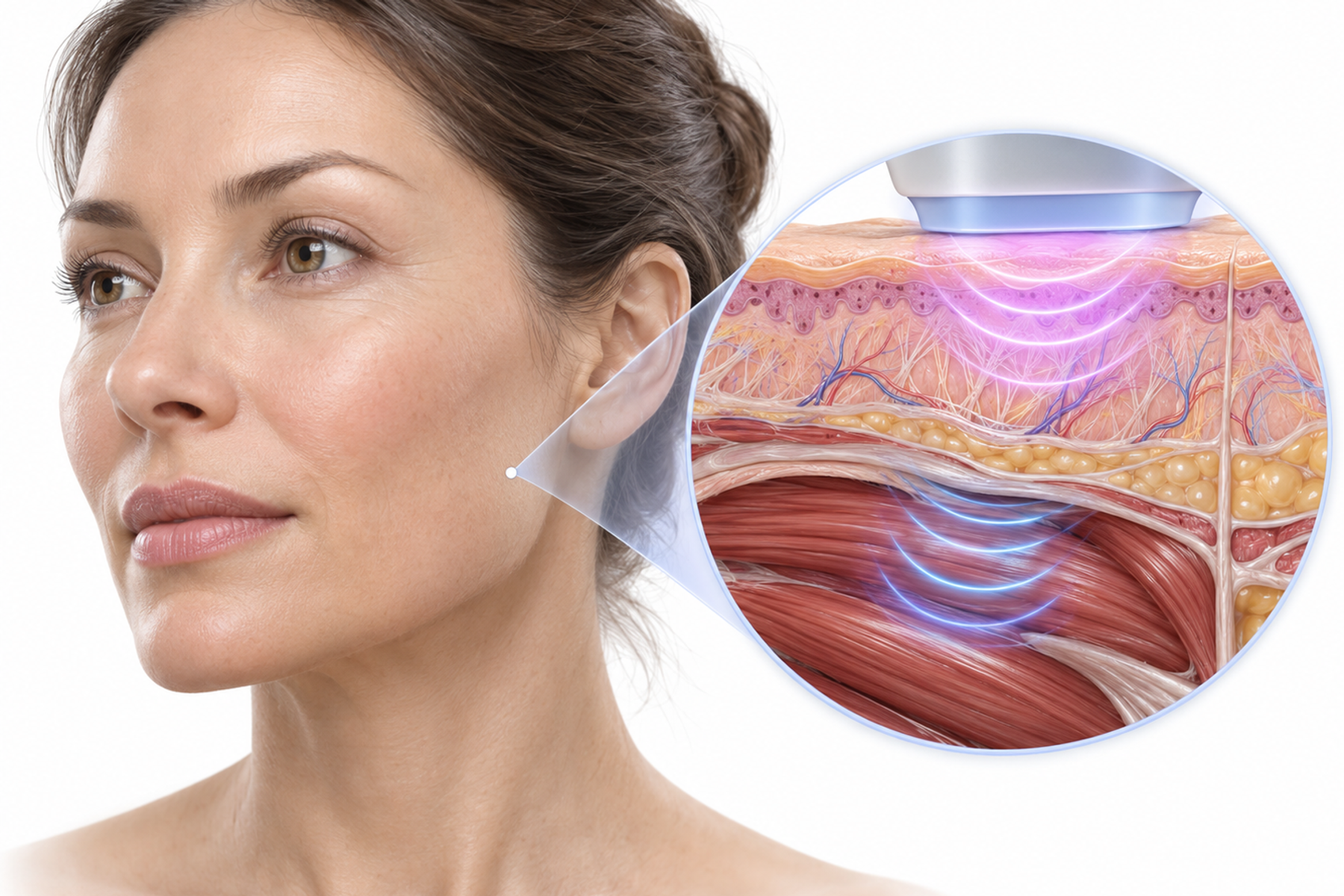
How does TriLift tighten and lift the face without surgery?
Facial aging involves more than changes at the skin's surface. Over time, the appearance of the face can change because of reduced skin elasticity, altered facial muscle tone, shifting fat compartments and changes in underlying support structures.
TriLift, developed by Lumenis, approaches facial rejuvenation through multiple tissue layers rather than focusing exclusively on the skin.
The system combines technologies for muscle activation, radiofrequency skin tightening and, when included in the treatment plan, RF microneedling.
These technologies aim to support a firmer, more defined facial appearance while preserving natural facial features.
Patients interested in this approach can explore TriLift facial toning and lifting in Montreal to understand how it fits into a personalized aesthetic treatment plan.
TriLift does not replace a surgical facelift. It is intended for more modest aesthetic changes, and results vary according to the individual and treatment protocol.
What are the 3 technologies used in TriLift?
How does Dynamic Muscle Stimulation work?
Dynamic Muscle Stimulation, known as DMSt™, uses controlled electrical stimulation to activate selected facial muscles.
Unlike conventional skin treatments, this technology directly addresses muscle conditioning. A trained provider moves the applicator over targeted areas and adjusts the stimulation according to facial anatomy.
The objective is to improve the appearance of facial muscle tone and create a more defined-looking contour, particularly in areas such as the cheeks and lower face.
Patients feel repeated muscle contractions during this part of the treatment. The intensity can be adjusted.
How does TriPollar radiofrequency tighten the skin?
TriPollar® radiofrequency delivers controlled thermal energy to the skin.
This heating is intended to support dermal remodeling and improve the appearance of skin firmness and fine lines.
While DMSt focuses on facial muscles, radiofrequency focuses on the skin and its supporting structures.
The two technologies address different aspects of facial appearance and may complement one another.
What does TriLift RF microneedling add?
The original TriLift platform includes triFX™ radiofrequency microneedling, which combines skin resurfacing with controlled RF energy.
This component is intended to improve skin texture, fine lines and the appearance of skin quality.
Lumenis also markets a newer TriLift 2.0 platform featuring FibroBoost™ RF microneedling.
The exact technologies included in a patient's session depend on the device available at the clinic and the selected treatment protocol.
Because RF microneedling involves a different level of skin intervention from non-invasive muscle stimulation, its recovery requirements may also differ.
Can TriLift improve jowls, cheeks and the jawline?
TriLift may be considered when patients notice early changes in facial contours, such as reduced cheek definition, mild lower-face laxity or less distinct jawline contours.
Potential treatment goals include:
Improving the appearance of cheek muscle tone.
Supporting more defined-looking lower facial contours.
Improving mild skin laxity.
Softening the appearance of selected fine lines.
Improving overall facial skin texture when the appropriate skin treatment component is included.
These improvements are usually more subtle than the changes achievable through surgical lifting.
For example, someone with mild changes in jawline definition may be a more suitable candidate than someone with significant loose skin or pronounced jowls.
TriLift does not replace lost facial fat or remove excess skin.
Patients whose primary concern is loose skin may also want to discuss Sofwave ultrasound skin tightening in Montreal, which uses a different energy-based approach.
How many TriLift sessions will I need?
A series of treatments is generally recommended rather than relying on a single session.
At Ideal Body Clinic, a package of 5 TriLift sessions is available. The number of sessions recommended for an individual patient depends on facial anatomy, skin quality, treatment objectives and response.
Some patients notice a temporary change in facial appearance after an initial session, while more sustained improvements may develop progressively.
A study published in Dermatologic Surgery in September 2026 evaluated a combined radiofrequency, microneedle radiofrequency and dynamic muscle stimulation approach.
Participants received 3 treatments at monthly intervals. Researchers reported improvements in facial wrinkles and overall appearance during follow-up at 1, 3 and 6 months after treatment.
The study supports the potential of this combined approach, but does not establish that every TriLift protocol produces identical results.
Maintenance recommendations should be individualized following the initial treatment series.
How much does TriLift cost in Montreal?
At Ideal Body Clinic, the regular package price is:
Treatment
Price
TriLift facial rejuvenation, 5 sessions
$1,600
The package averages $320 per session before applicable taxes.
The final treatment plan may depend on the areas being treated and whether additional skin-focused modalities are recommended.
Package inclusions and current availability should be confirmed when booking.
A consultation can also help determine whether a different treatment would better address your primary concern.
What does a TriLift session feel like?
A TriLift session begins with an assessment of the face and treatment goals.
During DMSt, patients feel rhythmic contractions as selected facial muscles are stimulated.
The TriPollar RF component produces a warming sensation as controlled energy is delivered to the skin.
According to Lumenis, the facial muscle-stimulation treatment typically takes approximately 20–30 minutes. Sessions involving additional technologies may require more time.
Patients may notice temporary changes in the appearance of the treated area immediately following the appointment.
Treatment settings are selected according to individual tolerance and the provider's assessment.
Is there downtime after TriLift?
Downtime depends on which technologies are used.
The non-invasive muscle stimulation and radiofrequency components are generally associated with little interruption to daily activities.
Temporary redness, warmth or swelling may occur.
If RF microneedling is included, recovery may be more involved because the procedure acts directly on the skin.
Lumenis identifies possible adverse effects that include redness, swelling, bruising, pigmentation changes, burns and scarring. These risks do not occur in every patient, but they should be discussed before treatment.
Patients should receive specific aftercare instructions suited to their treatment.
Those considering more intensive skin resurfacing can also compare Secret PRO CO2 laser and RF microneedling, which addresses different skin concerns and has its own recovery considerations.
Who should not have TriLift?
TriLift is not suitable for every patient.
According to the manufacturer, contraindications include implanted electronic devices such as pacemakers or defibrillators, and metal implants in the treatment area.
Pregnancy, breastfeeding, certain medical conditions, active skin problems, impaired healing and recent aesthetic procedures may also make treatment unsuitable or require further assessment.
Patients should disclose their medical history, implants, medications and recent procedures before treatment.
The complete contraindication checklist must be reviewed against the manufacturer's instructions for the specific device.
Is TriLift better than Botox, fillers or Sofwave?
There is no single best treatment for every form of facial aging. Each option addresses a different concern.
Treatment
Main treatment focus
TriLift
Facial muscle conditioning, skin firmness and texture
Sofwave
Ultrasound-based skin tightening
Botox
Temporary relaxation of selected muscles associated with expression wrinkles
Hyaluronic acid fillers
Restoring or enhancing facial volume and contours
RF microneedling
Skin texture, fine lines and dermal remodeling
TriLift does not provide the same volume correction as injectable fillers.
Similarly, it does not work by relaxing facial muscles in the way botulinum toxin does.
For patients concerned primarily about expression wrinkles, Botox injections in Montreal may be a more relevant treatment to discuss.
The best approach depends on whether the main concern involves muscle tone, skin laxity, volume loss or a combination of these factors.
How long do TriLift results last?
TriLift results are not permanent.
Facial aging continues after treatment, and the duration of improvement depends on individual characteristics and the technologies used.
In the September 2026 randomized controlled trial of the combined technology approach, improvements remained measurable at 6 months following a three-treatment series, although some reduction in the effects was observed over time.
That result should not be interpreted as a guaranteed duration for an individual patient.
A provider may recommend reassessment or maintenance sessions based on the observed response.
Is TriLift worth considering for natural-looking facial rejuvenation?
TriLift may be worth considering when the goal is to improve facial definition and skin firmness without surgery or injectable volume replacement.
Its main distinction is the combination of facial muscle stimulation with skin-focused radiofrequency technologies.
The treatment is most appropriately approached with realistic expectations. Changes may be gradual, the degree of improvement differs among patients, and more advanced facial laxity may require another treatment strategy.
At Ideal Body Clinic in Montreal, a personalized consultation can help identify the main causes of a patient's facial concerns and determine whether TriLift belongs in their treatment plan.
Results vary from person to person and are not guaranteed. Nothing here is medical advice — book a consultation and we will look at your case.
Sources
- https://lumenis.com/aesthetics/products/trilift/ [Lumenis, TriLift product technologies, clinical information, contraindications and adverse effects]
- https://blog.lumenis.com/aesthetics/introducing-trilift-achieve-a-facelift-like-effect/ [Lumenis, original TriLift mechanism, DMSt treatment duration and modalities]
- https://pubmed.ncbi.nlm.nih.gov/42766316/ [Dermatologic Surgery, September 2026, randomized controlled trial of combined RF, microneedle RF and dynamic muscle stimulation]
Keep reading
Does Sofwave tighten the face and neck without surgery?
Sofwave can improve mild facial and neck skin laxity without surgery. See how ultrasound treatment works, when results appear, what recovery involves, and Montreal prices.
Read
Body Contouring Compared: EMSCULPT NEO, CoolSculpting and Venus Bliss MAX
EMSCULPT NEO, CoolSculpting and Venus Bliss MAX reduce fat by three different mechanisms, and only two of them build muscle. Here is what each one does, which areas it treats, how many sessions to expect and how they combine.
Read
Bladder Leaks After Childbirth: Which Treatments Help?
About one in three women leak urine in the first year after having a baby. Here is the order that works: pelvic floor training first, Emsella when progress plateaus, and a doctor for anything more.
Read