Blog
2026 · 8 min read
Emsella: How Many Sessions, Who It Is For, and Who Should Wait
Emsella uses focused electromagnetic energy to contract the pelvic floor while you sit fully clothed. Here is how many sessions are usual, who tends to benefit, the contraindications and what to expect.
Key facts
- Emsella delivers high-intensity focused electromagnetic (HIFEM) energy through a chair, producing thousands of pelvic floor contractions in a 28-minute session while you stay clothed.
- The usual course is six sessions over about three weeks, twice a week. Some people add maintenance sessions later.
- It is designed for stress, urge and mixed urinary incontinence linked to a weakened pelvic floor, including after childbirth and around menopause.
- Pacemakers, implanted defibrillators, metal in the pelvic area, pregnancy and certain neurological conditions are among the contraindications reviewed before the first session.
- Published studies report improvement in leakage and quality-of-life scores after a course, with effects measured out to several months.
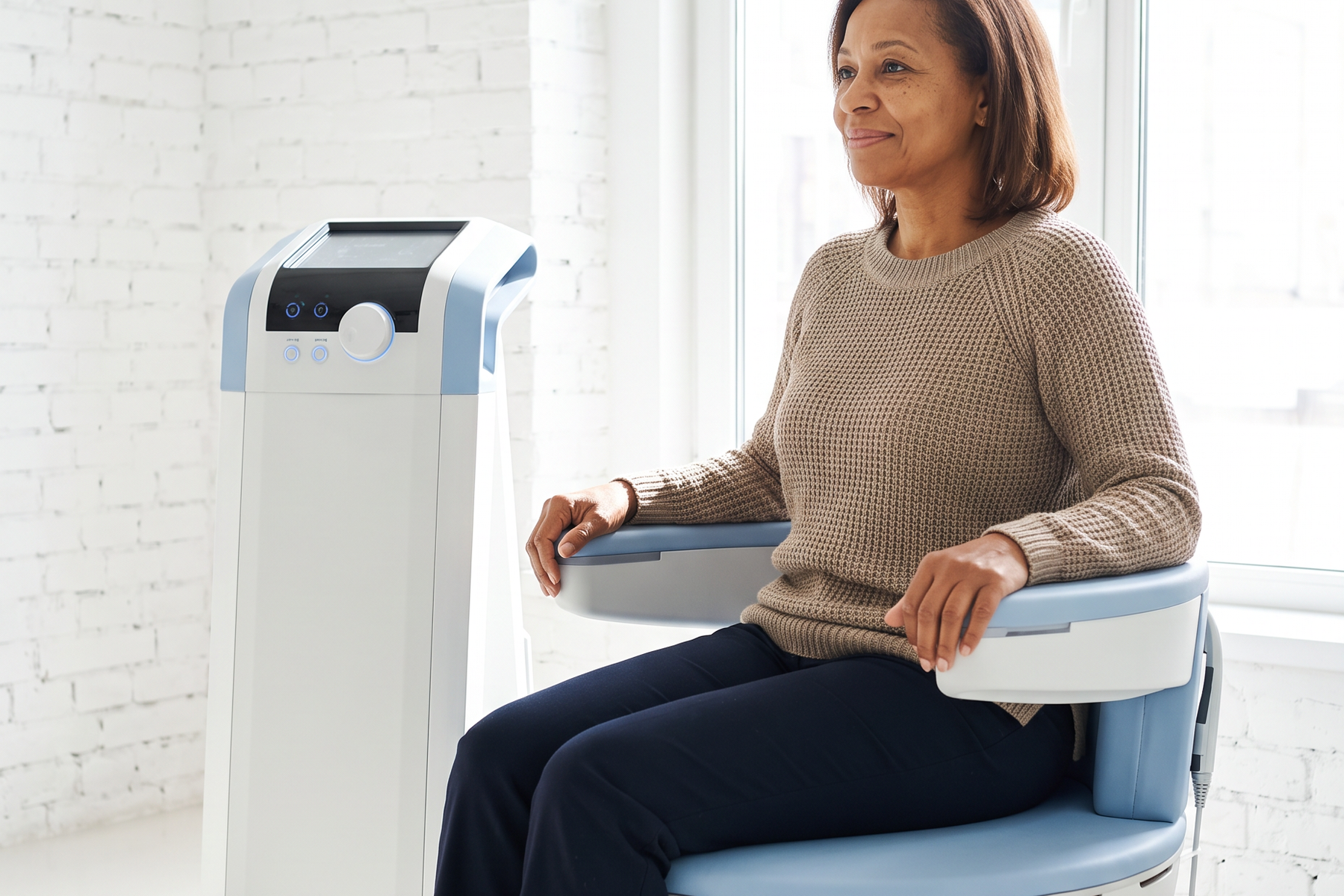
Emsella is a chair that uses high-intensity focused electromagnetic (HIFEM) energy to stimulate the pelvic floor muscles. You sit on it fully clothed for 28 minutes while the field triggers thousands of contractions that would be difficult to reproduce with voluntary exercise.
It is used for urinary incontinence and pelvic floor weakness. This article covers the questions we hear most often: how many sessions are needed, who tends to benefit, who should not use it, what a session feels like, when to expect results and what it costs in Montreal.
What does the Emsella chair actually do?
The pelvic floor is a sling of muscle that supports the bladder, bowel and, in women, the uterus. When it weakens, the bladder neck loses support and urine can leak with coughing, laughing, sneezing or exercise. That pattern is called stress incontinence. A sudden, hard-to-postpone need to go is called urge incontinence, and many people have a mix of both.
Emsella's electromagnetic field passes through clothing and tissue and depolarises the motor nerves that control the pelvic floor. The muscles contract in response, at a frequency and intensity set by the device rather than by conscious effort. The manufacturer describes each session as delivering thousands of supramaximal contractions.
Over a course of sessions, the aim is the same as with any strength training: a stronger, better-coordinated muscle that supports the bladder more effectively. Emsella is licensed by Health Canada as a medical device; licence details for BTL devices can be checked in the Medical Devices Active Licence Listing. You can read how the treatment is offered at our clinics on our Emsella treatment in Montreal page.
What does the research say?
Published studies on HIFEM pelvic floor stimulation report improvement in incontinence questionnaires and pad use after a course of six sessions, with follow-up at three and six months. A 2019 study in Lasers in Surgery and Medicine followed 75 women and reported improvement in quality-of-life scores and reduced pad use after six sessions, with the effect largely maintained at follow-up.
A later comparative study in women with stress urinary incontinence after childbirth found greater improvement in pelvic floor measures with HIFEM than with a course of electrical stimulation.
These studies are encouraging, but they are not a guarantee for every person. Incontinence has several causes, and Emsella addresses the muscular one. Where the cause is different, for example an overactive bladder without pelvic floor weakness, a medical assessment comes first.
How many Emsella sessions do you need?
The standard course is six sessions of 28 minutes, twice a week, over about three weeks. That is the protocol used in the published studies and the one we follow at the clinic.
Some people notice a difference after the first two or three sessions, often as an easier time holding on when the urge arrives. For most, the clearer change comes toward the end of the course and in the weeks after it, as the muscle adapts.
After the initial course, maintenance is individual. Some people book a single session every few months to keep the effect; others return for a shorter series when they notice symptoms creeping back. There is no fixed rule, and the follow-up visit at the end of the course is when this is discussed.
Who is a good candidate for Emsella?
Emsella is designed for people with:
Stress urinary incontinence, where leakage happens with effort such as coughing, running or lifting.
Urge or mixed incontinence linked to pelvic floor weakness.
Pelvic floor weakness after pregnancy and childbirth, once the postpartum check-up has been done and the practitioner has cleared the treatment.
Changes around menopause, when lower oestrogen affects muscle tone and tissue support.
Reduced pelvic sensation or difficulty performing Kegel exercises effectively, where the device does the contraction for you.
Men are also treated, most often for urinary leakage after prostate surgery or with age-related pelvic floor weakness.
It suits people who want a non-invasive option that does not require undressing, needles or downtime, and who can commit to the twice-weekly schedule for three weeks.
Who should not use Emsella?
The electromagnetic field is the reason for most of the contraindications. Emsella is not used if you have:
A pacemaker, implanted defibrillator or other electronic implant.
Metal in or near the pelvic area, including a copper intrauterine device, hip replacement, plates or screws.
Pregnancy, or a recent delivery before the postpartum check-up.
A pulmonary insufficiency or a serious heart condition.
Epilepsy or another seizure disorder, or a neurological condition that could be affected by electromagnetic stimulation.
Malignant tumours, or a history of cancer in the pelvic area without medical clearance.
Menstruation on the day of the session is not a contraindication, but many people prefer to schedule around it for comfort. Recent pelvic surgery, active infection and unexplained pelvic pain are reasons to wait and to see a physician first.
The health questionnaire before your first session covers all of these. If anything is uncertain, we ask for a note from your physician rather than proceeding.
What does a session feel like?
You arrive, empty your bladder and sit on the chair in your normal clothes. Thick seams, zips or metal in the seat area of your clothing are best avoided; light, non-metallic clothing is ideal.
Once the session starts, you feel a deep tingling and tapping in the pelvic area. The intensity is increased gradually to a level you find strong but comfortable. It is not painful. Most people describe it as an intense workout that they are not doing themselves.
The session lasts 28 minutes. Afterwards you can go straight back to your day. Some people feel mild muscle fatigue or soreness in the pelvic region for a day, similar to the feeling after exercise. There is no other downtime.
When do results show, and how long do they last?
Early improvement often appears during the course, typically as fewer leaks with coughing or sneezing, or a longer window between the urge and the need to reach a toilet. The fuller result develops in the weeks after the sixth session as the muscle fibres adapt.
The published follow-up data run to about six months, with most of the benefit maintained at that point. Beyond that, the duration depends on the same factors that affect any muscle: overall activity, body weight, hormonal changes and whether the pelvic floor keeps being used. Maintenance sessions are the usual way to extend the effect.
Some people combine Emsella with a pelvic floor physiotherapy programme. The two approaches complement each other: the physiotherapist works on coordination and daily habits, while the chair provides the volume of contractions that builds strength.
Does Emsella help after childbirth or with intimacy?
Pelvic floor weakness after childbirth is one of the most common reasons people book Emsella. The treatment is usually started after the postpartum check-up, typically six weeks or more after delivery, once the practitioner confirms there are no contraindications such as an intrauterine device with metal components.
A stronger pelvic floor also affects sensation and muscle control during intimacy, and many patients report improvement in that area. The published studies focused on incontinence and quality-of-life measures, so this is best understood as a reported benefit rather than a primary indication.
How much does Emsella cost in Montreal?
Our Emsella page lists the current price range for a single session and for the six-session package. The package reflects the standard course and is the way most people book. Maintenance sessions are priced individually.
A consultation is included before the first session to review the questionnaire, confirm that Emsella suits your symptoms and set the schedule.
What is the first step?
Book a consultation at one of our three clinics in the Montreal area. Come prepared to describe when leakage happens, how often and what you have tried so far, including pelvic floor exercises or physiotherapy. If you have had pelvic surgery or have any implant, mention it at the time of booking so the practitioner can review it before your visit.
You can also browse all of our treatments to see the other options available for body and wellness concerns.
Results vary from person to person and are not guaranteed. Nothing here is medical advice — book a consultation and we will look at your case.
Sources
- https://idealbodyclinic.com/emsella-treatment-montreal/
- https://health-products.canada.ca/mdall-limh/
- https://btlaesthetics.com/en/for-providers/emsella-providers
- https://pubmed.ncbi.nlm.nih.gov/31172580/
- https://pubmed.ncbi.nlm.nih.gov/31860567/
- https://pubmed.ncbi.nlm.nih.gov/39760417/
- https://pubmed.ncbi.nlm.nih.gov/40909763/
Keep reading

Botox vs. Dermal Fillers: What Is the Difference?
Botox relaxes facial muscles to soften expression lines, while dermal fillers restore volume and enhance contours. Compare results, longevity, prices, and treatment options.
Read
How Can You Improve Neck Wrinkles and a Double Chin?
Neck wrinkles, sagging skin and a double chin can improve with treatments targeting collagen, skin laxity or excess fat. Discover which options work for each concern in Montreal.
Read
Can TriLift Facial Muscle Stimulation Lift Your Face?
TriLift uses facial muscle stimulation and radiofrequency to improve the appearance of facial contours. Discover how it works, which areas it targets, and what results to expect.
Read