Blog
2026 · 8 min read
Sofwave: What It Lifts, What It Does Not, and Who It Suits
Sofwave uses parallel ultrasound beams to heat the mid-dermis and rebuild collagen in the brow, under the chin and along the neck. Here is what it changes, what it cannot do, how it compares with Ultherapy, RF microneedling and thread lifts, and who tends to benefit.
Key facts
- Sofwave delivers parallel ultrasound beams to a fixed depth of 1.5 mm, heating the mid-dermis so that new collagen and elastin form. It is cleared to lift the brow, the under-chin area and the neck and to improve fine lines and wrinkles.
- Most people need one session of 30 to 60 minutes. There is no downtime beyond a few hours of redness, mild swelling or tingling.
- Early tightening can show within one to two weeks, and the result builds over about 12 weeks as collagen forms. Studies have followed the improvement to six months, and a yearly maintenance session is a common plan.
- The change is measurable but moderate: a firmer contour and a lift of a few millimetres. Good candidates have mild to moderate laxity; marked skin excess or heavy under-chin fullness calls for another plan.
- Ultherapy treats deeper layers with focused ultrasound, RF microneedling works on texture with needles and heat, and a thread lift repositions tissue mechanically. The assessment decides which one fits.
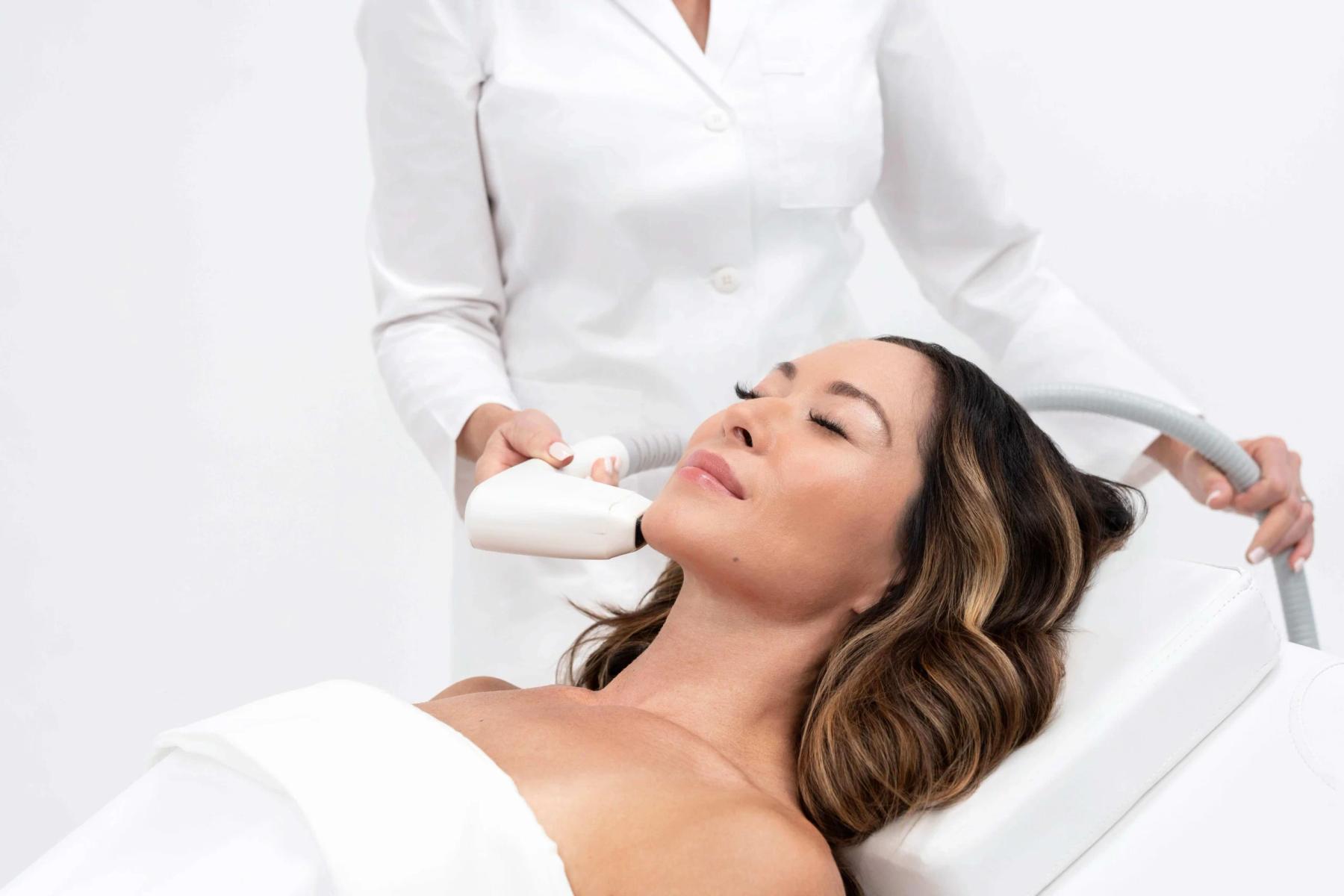
Sofwave is a non-invasive ultrasound device that tightens skin by heating the middle layer of the dermis at a set depth. It is licensed as a medical device in Canada and cleared to lift the eyebrow, lift lax tissue under the chin and along the neck, and improve fine lines and wrinkles on the face. A single session is the usual protocol.
The name comes up in searches alongside Ultherapy, and the two are often confused. This guide explains how Sofwave works, what a session involves, when the result appears, how much change is realistic, who tends to be a good candidate, and how it compares with Ultherapy, radiofrequency microneedling and thread lifts.
What is Sofwave and what is it cleared to treat?
Sofwave is built around what the manufacturer calls Synchronous Ultrasound Parallel Beam technology, or SUPERB. Rather than focusing energy on a series of tiny points, the handpiece carries several transducers that fire together, so each pulse heats a band of tissue at one consistent depth.
The device is cleared to improve facial lines and wrinkles, lift the eyebrow, and lift lax submental (under-chin) and neck tissue in adults aged 22 and older. Sofwave holds a Health Canada medical device licence, listed in the Medical Devices Active Licence Listing. The areas we treat with it are described on our Sofwave skin tightening in Montreal page: the brow, the under-chin area, the neck, and the face for fine lines and wrinkles.
How does Sofwave tighten skin?
Skin laxity develops as the collagen and elastin fibres in the dermis thin out and lose their organisation. Energy devices create a controlled thermal injury in the dermis that the body repairs by laying down new fibres.
Sofwave's transducers deliver high-frequency ultrasound to a fixed depth of 1.5 mm, the mid-dermis. Tissue at that depth is brought to the temperature at which collagen contracts and fibroblasts, the cells that make collagen, are activated. Above it, an integrated cooling system called Sofcool protects the epidermis. Below it, the fat and the deeper support layers of the face are not reached.
Skin biopsies taken after Sofwave treatment have shown a gradual increase in collagen and elastin, with the dermal fibres realigning in parallel, and continued production of glycosaminoglycans, the molecules that hold water in the dermis, at follow-ups extending to ten months. Because ultrasound is not absorbed by pigment, all skin tones can be treated.
What does a session involve, and what does it feel like?
After photographs, the skin is cleaned and a gel is applied so the handpiece makes full contact. The practitioner then works across the area in a grid, one pulse at a time. Each pulse lasts one to two seconds and is felt as a wave of heat that builds quickly and fades. Some pulses feel sharper than others, particularly over bone at the brow and jawline. Comfort measures, including a topical anaesthetic cream, are discussed at the consultation.
Treating the full face and neck takes 30 to 60 minutes; a single zone takes less. The number of passes over each area follows the treatment protocol.
There is no downtime. The treated skin may be pink, slightly swollen or tingly for a few hours. Makeup can be applied straight away and normal activities resume the same day. No special skin care is required beyond sun protection.
When do results appear and how long do they last?
Some tightening can be noticed within one to two weeks, from the immediate contraction of heated collagen. The larger part of the result comes from new collagen, which takes time to build. Improvement continues over roughly 12 weeks, and the result is usually assessed at the three-month mark.
Clinical studies of the device have followed patients to six months with the improvement holding stable. Aging does not stop, however, so the tightening gradually gives ground to the ongoing loss of collagen. Many people plan a maintenance session about once a year.
Most people need a single session. A second session may be recommended depending on the degree of laxity and the response to the first, usually spaced three or more months later.
How much change is realistic?
Sofwave produces a measurable, moderate improvement rather than a dramatic one. In a study that tracked skin movement with three-dimensional imaging after a single full-face and under-chin treatment, the average contraction was just under two millimetres at eight weeks and held at 24 weeks. In practice this reads as a firmer jawline, a smoother under-chin area, a brow that sits slightly higher and fine lines that are softened, with an overall improvement in skin texture.
What Sofwave does not do is remove excess skin, reposition deeper tissue or reduce a substantial volume of fat. It does not replace a surgical facelift or neck lift for advanced laxity, and it does not change the shape of the face. It suits people who want their own features, a little firmer, without surgery or needles.
Who is a good candidate, and who is not?
The treatment is designed for mild to moderate laxity. The typical candidate is an adult in their thirties to sixties with early softening along the jawline, a loss of firmness under the chin or on the neck, a brow that has settled lower, or fine lines that have become more visible, who wants a gradual, natural-looking improvement with no recovery time.
Sofwave is contraindicated where there are open wounds or lesions in the area, severe or cystic acne in the area, or a pacemaker or other electronic implant in the region being treated. The manufacturer also lists precautions that the consultation reviews: pregnancy or breastfeeding; an active infection or a skin disease that affects healing; significant scarring or a metal implant in the area; an oral retinoid within the past six months; and blood-thinning medication within the past two weeks. Treatment directly over dermal filler is not recommended, so the timing of any filler is coordinated with the session.
Sofwave, Ultherapy, RF microneedling or a thread lift: how do they compare?
These four treatments are often searched together, and each works differently.
Ultherapy uses micro-focused ultrasound with visualisation. It focuses energy on tiny points at depths of 1.5, 3.0 and 4.5 mm, which lets it reach the deep dermis and the SMAS, the fibrous layer that surgeons tighten during a facelift. Sofwave delivers energy in parallel lines at a single depth of 1.5 mm and does not reach the SMAS. In return, it treats a broader band of dermis with each pulse and keeps the energy away from the fat layer, which matters in thinner faces. Ultherapy is often chosen when the laxity sits in the deeper layers; Sofwave for dermal laxity and skin quality.
Radiofrequency microneedling, such as our Scarlet RF microneedling treatment, delivers heat through fine insulated needles inserted into the dermis. The mix of mechanical and thermal injury makes it particularly useful for texture, pores, acne scarring and overall skin quality, with some tightening. It involves needle punctures, a day or two of redness, and usually a series of three sessions. Sofwave uses no needles, is a single session, and is more specifically a lifting and tightening treatment.
A PDO thread lift repositions tissue mechanically. Barbed threads placed under the skin pull the jowl or brow into a new position, so the change is visible on the day and larger in degree than what heat alone produces. It involves entry points, some bruising and swelling, and a week of restrictions, and the result lasts 12 to 18 months.
What are the side effects and risks?
Expected effects are limited to redness, mild swelling and tenderness in the treated area for a few hours, occasionally a day or two. A faint tingling or numbness in a patch of skin can occur and resolves on its own.
Less common effects listed by the manufacturer include bruising, persistent redness or swelling, changes in skin pigmentation and, rarely, a small area of ulceration where energy has been concentrated. Correct technique, appropriate pulse settings and the cooling of the epidermis are the safeguards. In the published clinical studies of the device, no adverse events were reported. Sun protection for a few weeks after the session protects the skin while it remodels.
How much does Sofwave cost in Montreal?
Pricing depends on the zone treated, and on whether one zone or the full face and neck are done in the same visit. Our Sofwave page lists the current range by area, and the exact quote is confirmed at the consultation once the plan and the number of zones are set. Because the protocol is one session, the quote covers the whole treatment rather than the first of a series.
What is the first step?
Book a consultation at one of our three clinics in the Montreal area. The assessment looks at where the laxity actually sits, how thick the skin and underlying tissue are, and whether any of the precautions above apply. Bring a list of current medications and note any recent filler in the area, since these affect timing.
You can also browse our full range of aesthetic treatments to see where Sofwave fits alongside other options for the face and neck.
Results vary from person to person and are not guaranteed. Nothing here is medical advice — book a consultation and we will look at your case.
Sources
- https://idealbodyclinic.com/sofwave-skin-tightening-treatment-montreal/
- https://sofwave.com/
- https://health-products.canada.ca/mdall-limh/
- https://pubmed.ncbi.nlm.nih.gov/38031530/
- https://pubmed.ncbi.nlm.nih.gov/36757157/
- https://pubmed.ncbi.nlm.nih.gov/41405933/
- https://pubmed.ncbi.nlm.nih.gov/32026164/
Keep reading

Laser Skin Rejuvenation After 40: Which Treatment Is Best?
After 40, the best laser depends on whether you want to treat wrinkles, pigmentation, texture or skin firmness. Compare Fotona 4D, Pico Laser, Laser Genesis and CO2 resurfacing.
Read
Can Fotona 4D Rejuvenate Your Face Without Surgery?
Fotona 4D combines four laser steps to improve facial firmness, fine lines and skin texture without surgery. Discover how it works, expected results, recovery and treatment costs.
Read
Preventative Botox: When Should You Start?
There is no perfect age to start preventative Botox. Discover when early expression lines may justify treatment, how it works, and what to consider in your 20s and 30s.
Read