Blog
2026 · 8 min read
Cat Eye and Fox Eye Thread Lifts: What They Change and Who They Suit
Cat eye and fox eye thread lifts reposition the outer brow and eye with dissolvable PDO threads. Here is what each one changes, who suits it, how long it lasts and what to expect.
Key facts
- A cat eye lift tilts the outer corner of the eye; a fox eye lift raises the tail of the brow. Both use dissolvable PDO threads placed under the skin.
- The lift is visible right away and settles over two to three months as the threads stimulate collagen. Results usually hold for 12 to 18 months.
- Good candidates have mild to moderate laxity and realistic expectations. Heavy skin excess or very thin skin at the temple usually calls for another plan.
- Swelling, bruising and tenderness at the entry points are the common effects. Dimpling, asymmetry and thread visibility are the risks a careful technique aims to avoid.
- Threads, filler and neuromodulator each do a different job at the outer eye. The assessment decides which one, or which combination, fits your face.
"Cat eye" and "fox eye" describe two related thread-lift techniques that reposition the outer part of the eye and brow with dissolvable polydioxanone (PDO) threads. Both are done in a single appointment with local anaesthetic, and both give an immediate lift that settles over the following weeks.
The two names are often used interchangeably online, but they aim at slightly different points on the face. This guide explains what each one changes, how the threads work, who tends to be a good candidate, what a session involves and how the options compare to filler and neuromodulator treatments.
What is the difference between a cat eye and a fox eye thread lift?
A cat eye lift targets the outer corner of the eye. The threads are anchored in the temple and pull the lateral canthal area upward and outward, so the eye reads as more almond-shaped and slightly tilted.
A fox eye lift targets the tail of the brow. The threads lift the outer third of the eyebrow, which opens the space between the brow and the upper lid and gives the eye a longer, more elongated line.
In practice, many people receive a combination. Lifting the brow tail alone can leave the outer eye looking unchanged, and lifting the eye corner alone can look heavy if the brow above it has dropped. The plan depends on where the descent actually is, which is why the assessment starts with photographs and a careful look at your brow position, lid skin and temple volume.
How does a thread lift around the eyes work?
PDO threads are made of the same material as dissolvable surgical sutures. Once placed under the skin, the material is absorbed over roughly six months. During that time, the body lays down new collagen along the path of the thread, which is why the effect outlasts the thread itself.
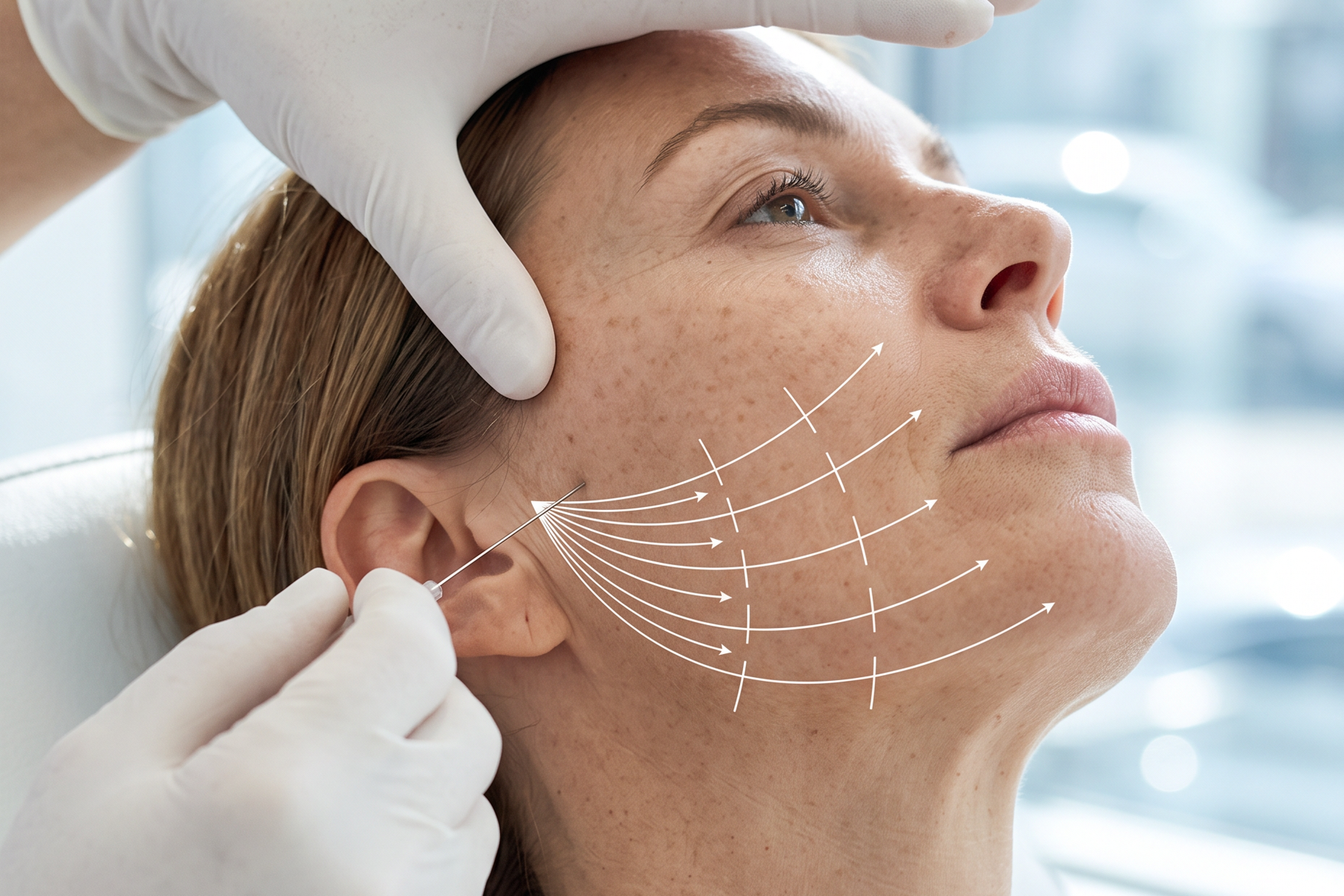
For the eye area, threads are introduced through a small entry point near the hairline with a fine cannula. The thread runs under the skin toward the outer eye or brow tail. Barbed or cog threads have tiny projections along their length that grip the tissue, so when the practitioner applies gentle tension, the tissue moves with the thread and holds in the new position.
The lift you see on the day comes from that mechanical repositioning. The improvement in skin quality that develops over the next two to three months comes from the collagen response. You can read more about how the threads are used elsewhere on the face on our PDO thread lifts in Montreal page.
Which threads are used for the eye area?
Two families of thread are common for this region:
Cog or barbed threads provide the actual lift. For the cat eye and fox eye, a small number of these threads, usually two to four per side, are placed from the temple toward the target point.
Mono threads are smooth, thinner threads with no barbs. They do not lift on their own. They are sometimes added around the outer eye and temple to improve skin texture and firmness, or to support a lift that has been done with cog threads.
Thread length, gauge and the number of threads are chosen for your tissue. A thicker thread grips better but is more likely to be felt or seen in thin skin, which is a real consideration at the temple and outer eye.
Who is a good candidate for a cat eye or fox eye lift?
Thread lifts around the eye work best for people who have:
Mild to moderate descent of the brow tail or outer eye, rather than heavy skin excess on the upper lid.
Enough tissue at the temple for the threads to anchor and remain hidden.
Realistic expectations. A thread lift produces a measurable but modest change of a few millimetres. It refines the line of the eye; it does not change its size.
Skin that is not markedly thin or crepey at the temple, since very thin skin is where thread visibility and dimpling are most likely.
If the main concern is loose upper-lid skin that folds over the lashes, threads will not correct it, and a surgical opinion is the more useful next step. If the concern is fine lines at the outer eye rather than position, neuromodulator treatment is often the more direct answer. Both of these are discussed during the consultation so that you are not booked for a treatment that cannot deliver what you are after.
What does the appointment involve?
The visit usually takes 45 to 60 minutes for the eye area alone. After photographs and marking, the skin is cleaned and a topical anaesthetic is applied, followed by a small injection of local anaesthetic at the entry points.
The threads are then placed with a cannula and tensioned to the planned position. You will feel pressure and some tugging, but the injected anaesthetic keeps the procedure comfortable for most people. Once the practitioner is satisfied with the symmetry, the thread ends are trimmed below the skin and the entry points are dressed.
You can leave straight afterwards. Most people plan the session for a day when they can rest that evening and avoid social plans for a couple of days while any bruising settles.
How long do cat eye and fox eye results last?
The initial lift is visible immediately, although early swelling can exaggerate it. Over the first two weeks, the swelling goes down and the position settles. From about the sixth week, the collagen response begins to firm the area, and the result is usually at its best between two and three months.
Most people keep a satisfying result for 12 to 18 months. The threads themselves have dissolved well before then; the longer-lasting part of the result is the collagen they left behind. A repeat session can be planned when the effect fades. Some people choose a lighter touch-up at 12 months to maintain the line rather than waiting for the full effect to wear off.
Lifestyle affects the duration. Significant weight change, smoking and frequent unprotected sun exposure all shorten how long any collagen-based result lasts.
What are the side effects and risks?
The expected effects are swelling, bruising and tenderness at the entry points and along the thread path. These generally settle within one to two weeks. Mild asymmetry in the first days is common while the swelling is uneven.
Less common effects include:
Dimpling or puckering of the skin where a barb has caught superficially. This usually resolves on its own within a few weeks, and it can be released by the practitioner if it does not.
Visible or palpable thread, most often in thin temple skin. Careful depth of placement and thread selection are the main safeguards.
Persistent asymmetry, which can be adjusted at a follow-up visit.
Infection at an entry point, which is uncommon and treatable when addressed early.
Thread extrusion, where an end works its way toward the surface. This is rare and is managed by trimming the exposed portion.
Aftercare reduces these risks. For the first week, you will be asked to avoid rubbing the area, sleeping face-down, vigorous exercise, saunas and dental work that requires wide mouth opening. Facial massages and other treatments in the same area are postponed for several weeks.
Thread lift, filler or neuromodulator: which is right for the outer eye?
These three treatments are often mentioned together for the outer eye, and each does something different.
A neuromodulator treatment relaxes the muscle that pulls the outer brow down. This can lift the brow tail by a millimetre or two and soften lines at the outer eye. It does not move tissue, so it cannot correct a brow that has descended because of laxity.
Hyaluronic acid filler can replace lost volume at the temple and support the brow tail from underneath. When temple hollowing is part of the picture, filler alone can give a subtle lift. It does not tilt the eye corner.
A thread lift physically repositions the tissue. It is the only one of the three that produces the actual cat eye or fox eye change.
Many treatment plans combine two of these. A common sequence is a neuromodulator treatment a couple of weeks before threads, so the brow depressor is relaxed while the threads settle, with filler added later if the temple needs support. The order and the combination come out of the assessment, not from a fixed package.
How much does a cat eye or fox eye thread lift cost in Montreal?
Pricing depends on the number and type of threads and on whether the eye corner, the brow tail or both are treated. Our PDO thread lift page lists the current range for face and body treatments, and the exact quote for the eye area is confirmed at the consultation once the plan is set.
A consultation before booking is worthwhile for this treatment in particular, because the difference between a good and a disappointing result lies mostly in candidate selection and planning.
What is the first step?
Book an assessment at one of our three clinics in the Montreal area. Bring any photos of the look you have in mind, and be ready to discuss previous treatments in the area, including filler or neuromodulator, since these affect how the threads are planned.
You can browse all of our aesthetic treatments to see how thread lifts fit alongside other options for the eye area.
Results vary from person to person and are not guaranteed. Nothing here is medical advice — book a consultation and we will look at your case.
Sources
- https://idealbodyclinic.com/pdo-thread-lifts-montreal/
- https://health-products.canada.ca/mdall-limh/
- https://pubmed.ncbi.nlm.nih.gov/39662017/
- https://pubmed.ncbi.nlm.nih.gov/30893160/
- https://pubmed.ncbi.nlm.nih.gov/31267809/
- https://pubmed.ncbi.nlm.nih.gov/25993611/
- https://pubmed.ncbi.nlm.nih.gov/35880467/
Keep reading
Botox vs. Dermal Fillers: What Is the Difference?
Botox relaxes facial muscles to soften expression lines, while dermal fillers restore volume and enhance contours. Compare results, longevity, prices, and treatment options.
Read
How Can You Improve Neck Wrinkles and a Double Chin?
Neck wrinkles, sagging skin and a double chin can improve with treatments targeting collagen, skin laxity or excess fat. Discover which options work for each concern in Montreal.
Read
Can TriLift Facial Muscle Stimulation Lift Your Face?
TriLift uses facial muscle stimulation and radiofrequency to improve the appearance of facial contours. Discover how it works, which areas it targets, and what results to expect.
Read