Blog
2026 · 9 min read
Does XERF Tighten Sagging Facial Skin Without Surgery?
XERF may improve mild facial skin laxity without surgery, but results vary. See what the research shows, how treatment works, and when changes may become visible.
Key facts
- XERF uses two radiofrequencies, 6.78 MHz and 2 MHz, with three adjustable treatment depths.
- At 90 days after treatment, 36 of 39 participants received clinician-rated improvement scores of at least 3 out of 5.
- A separate 2026 retrospective study assessed 16 women after one XERF treatment, with follow-up through three months.
XERF may help tighten mildly loose facial skin without surgery. In a 2026 clinical study, 36 of 39 participants received positive improvement ratings from clinicians 90 days after completing 2 treatments. Results vary, and long-term evidence is still developing.
For people with mild to moderate skin laxity, XERF may offer a non-invasive option, although it cannot reproduce the results of a surgical facelift.
How does XERF skin tightening work?
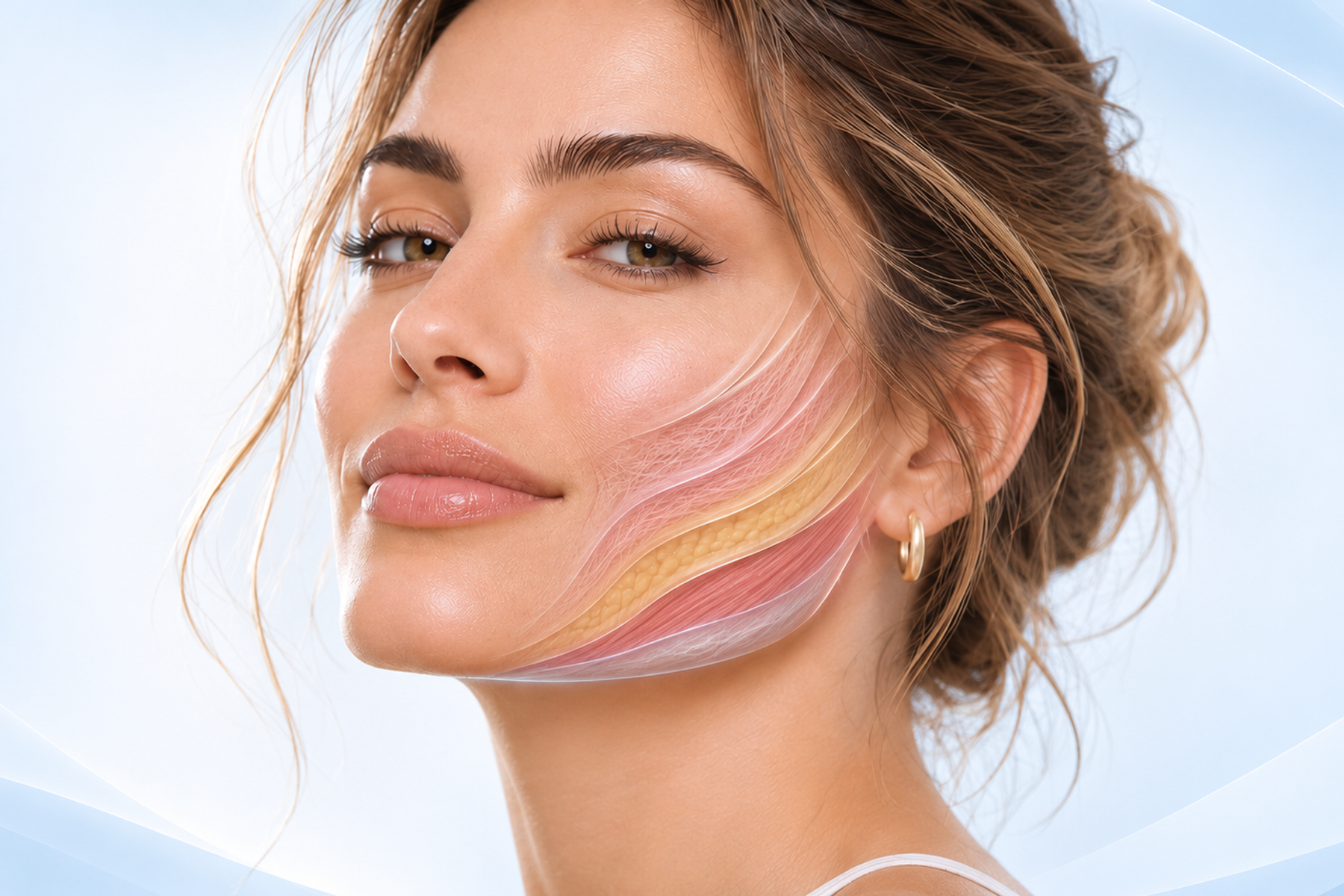
XERF is a non-invasive radiofrequency treatment developed by Cynosure Lutronic. It delivers controlled energy beneath the skin's surface to encourage tissue remodeling and improve the appearance of loose skin.
As we age, changes in collagen, elastin and the tissues supporting our facial structure contribute to wrinkles and sagging. Radiofrequency technology uses heat to influence these structures, encouraging a gradual tightening response.
XERF combines two radiofrequencies:
- 6.78 MHz: Designed to deliver controlled energy to targeted tissue.
- 2 MHz: Allows energy delivery at different tissue depths.
The system also offers three adjustable depth settings and multiple intensity levels. This allows the practitioner to adapt treatment according to the facial area and individual skin characteristics.
Unlike treatments that require needles, XERF delivers energy through a handpiece applied to the skin.
You can explore the areas treated and available options on our XERF skin tightening page in Montreal.
Does XERF really work for sagging skin?
Early clinical research has reported encouraging results, particularly for facial laxity and lower-face definition.
A 2026 prospective study involving 39 participants across four clinical sites evaluated the effects of XERF after two treatment sessions.
At 90 days after the final treatment, 36 of the 39 participants received a clinician-rated aesthetic improvement score of at least 3 on a five-point scale. Patient satisfaction was also assessed during the study.
Another study, published in 2026, reviewed 16 women who underwent one XERF session. Researchers reported improvements in selected facial measurements and skin-quality assessments over three months.
These findings are promising, but there are important limitations.
Both studies involved relatively small groups, and neither was a randomized controlled trial. Follow-up was limited, so the results do not establish exactly how long improvements will last.
For patients considering XERF, the practical message is straightforward: improvement is possible, but the degree of tightening differs from person to person.
Which areas of the face can XERF treat?
XERF can be used on several areas where skin laxity becomes noticeable with age.
Can XERF help lift the eyebrows?
XERF can target the forehead and brow area. Some clinical observations have reported improvements in eyebrow position, although results are generally subtle.
It may be considered by patients looking for a refreshed appearance without a surgical brow lift.
Can XERF improve the jawline and jowls?
The jawline is one of the areas commonly associated with age-related skin laxity.
XERF can be used to target loose skin around the lower face and jowls, with the aim of improving firmness and contour definition.
However, the treatment cannot remove significant excess skin or guarantee a sharply defined jawline.
Can XERF tighten the double chin and neck?
XERF can also treat the area beneath the chin and parts of the neck.
The goal is to improve skin firmness. A double chin caused primarily by excess fat may require a different approach than one caused by loose skin.
A consultation helps identify the underlying concern before choosing a treatment.
How many XERF sessions will I need?
There is no single number of sessions appropriate for every patient.
Published studies have assessed outcomes after both one and two treatments.
In the 39-participant study, patients received two sessions approximately four weeks apart, with follow-up assessments at 30 and 90 days after the final treatment.
A separate retrospective study evaluated outcomes following one session.
Your recommended treatment plan will depend on several factors:
- The degree of skin laxity
- The facial area being treated
- Your skin characteristics
- Your aesthetic goals
- Your response to the initial treatment
Some patients may choose one session, while others may be advised to consider additional treatment.
The decision should be based on individual assessment rather than a fixed package for everyone.
When will I see XERF results?
XERF results may develop gradually.
Radiofrequency energy produces a thermal response in the targeted tissues. Subsequent remodeling takes time, which is why the appearance of the skin can continue changing after treatment.
In published clinical research, improvements were assessed at approximately one month and three months after treatment.
Some patients may notice an early change in skin firmness, while others experience more gradual improvement.
It is important to distinguish an immediate sensation of tightening from a lasting cosmetic result.
Because long-term XERF-specific research remains limited, the precise duration of improvement cannot be predicted for every patient.
Your practitioner can discuss realistic expectations based on your skin and treatment plan.
Does XERF hurt or require downtime?
XERF was developed with patient comfort in mind.
Its technology includes Wave Fit™ energy delivery and an integrated cooling system designed to manage skin-surface temperature during treatment.
Most patients experience a warming sensation as the handpiece passes over the treatment area.
In a study involving 16 patients, the average reported pain score was approximately 4.3 out of 10, although individual experiences varied.
One advantage of XERF is that needles and routine numbing are generally not required.
Downtime is typically minimal. In published studies, reported reactions included temporary redness and mild swelling, which resolved during follow-up.
However, no energy-based treatment is entirely without risk. The absence of serious complications in small studies does not mean complications are impossible.
Your provider will explain potential side effects and the appropriate aftercare for your treatment.
Is XERF better than other skin-tightening treatments?
The best skin-tightening treatment depends on what you want to improve.
XERF is one option among several technologies used for facial rejuvenation. Different devices deliver energy in different ways, and their results should not be assumed to be identical.
For example, Sofwave skin tightening uses ultrasound technology rather than radiofrequency.
Another option, Secret PRO RF microneedling, combines radiofrequency with microneedling technology and may be considered when skin texture is also a concern.
XERF does not use needles. This makes it particularly relevant for patients looking for a non-invasive treatment.
There is not enough direct comparative evidence to conclude that XERF produces better results than every alternative.
A proper consultation should consider your facial structure, skin condition, desired results and tolerance for recovery time.
Who is a good candidate for XERF?
XERF may be worth considering if you have noticed early changes such as:
- Mild to moderate skin laxity
- Less definition along the jawline
- Early jowling
- Loose skin beneath the chin
- Changes in facial firmness
- Fine lines associated with skin aging
It may appeal to patients who want gradual changes without injections or surgery.
However, XERF is not necessarily suitable for every person or every type of facial aging.
Before treatment, your provider should review your health history, existing medical devices or implants, skin concerns, recent aesthetic procedures and other relevant factors.
Patients expecting the degree of lifting achieved through surgery may need to consider other options.
The purpose of consultation is to determine whether XERF is appropriate, not simply to recommend a procedure.
Where can I get XERF in Montreal?
Ideal Body Clinic is introducing XERF at its Monkland location, 6000 Monkland Avenue in Montreal, with the first treatments planned for December 2026.
Appointments are approximately 45 minutes, depending on the area being treated.
During your consultation, our team can discuss which areas you would like to address, explain the treatment process and recommend a personalized approach.
Visit our Monkland clinic location page for location details.
Is XERF worth considering for facial rejuvenation?
If you want to address early skin laxity while keeping your natural appearance, XERF may be an option to explore.
Its dual-frequency technology offers a non-invasive approach to skin tightening, and early studies have shown encouraging short-term outcomes.
The most important consideration is whether the treatment matches your specific needs and expectations.
At Ideal Body Clinic, we focus on helping you understand your options and choose a plan that makes sense for you.
Book your personalized XERF consultation at Ideal Body Clinic.
Monkland, Montreal | 514-998-0998
Results vary. A professional assessment is necessary to evaluate treatment suitability, potential risks and expected outcomes.
Results vary from person to person and are not guaranteed. Nothing here is medical advice — book a consultation and we will look at your case.
Sources
- https://health-products.canada.ca/mdall-limh/information?lang=eng&licenceId=113060&type=active [Health Canada, Medical Devices Active Licence Listing, XERF, Licence No. 113060]
- https://pubmed.ncbi.nlm.nih.gov/41930066/ [Weiss et al., Cureus, 2026, prospective multicenter clinical study of 39 participants]
- https://www.cynosure.com/xerf/ [Cynosure Lutronic, official XERF technology specifications and treatment information]
Keep reading
Sofwave: What It Lifts, What It Does Not, and Who It Suits
Sofwave uses parallel ultrasound beams to heat the mid-dermis and rebuild collagen in the brow, under the chin and along the neck. Here is what it changes, what it cannot do, how it compares with Ultherapy, RF microneedling and thread lifts, and who tends to benefit.
Read
Laser Skin Rejuvenation After 40: Which Treatment Is Best?
After 40, the best laser depends on whether you want to treat wrinkles, pigmentation, texture or skin firmness. Compare Fotona 4D, Pico Laser, Laser Genesis and CO2 resurfacing.
Read
Can Fotona 4D Rejuvenate Your Face Without Surgery?
Fotona 4D combines four laser steps to improve facial firmness, fine lines and skin texture without surgery. Discover how it works, expected results, recovery and treatment costs.
Read