Blog
2026 · 8 min read
Fotona Laser Platform Explained: What Each Mode Does
Fotona is not one treatment but a laser platform with two wavelengths and many modes. Here is what each mode is for, who suits it, what a session involves, the downtime and how many sessions to expect.
Key facts
- Fotona is a platform, not a single treatment. Its Er:YAG wavelength works at the surface of the skin and its Nd:YAG wavelength heats deeper tissue, and each mode is a different way of using one or both.
- The modes cover resurfacing, skin tightening, Fotona 4D, eye contouring, anti-snoring, hair reduction, vascular lesions, warts and skin tags, acne and scars, and nail fungus, among others.
- Downtime depends on the mode. Non-ablative modes leave little more than warmth and redness; ablative resurfacing produces redness and peeling for two to three days.
- Most plans run from one to six sessions. Early improvement appears within days to weeks and the full result develops over two to six months as new collagen forms.
- The right mode comes out of a consultation. Skin type, tanning habits and medical history all change what can be treated and with which settings.
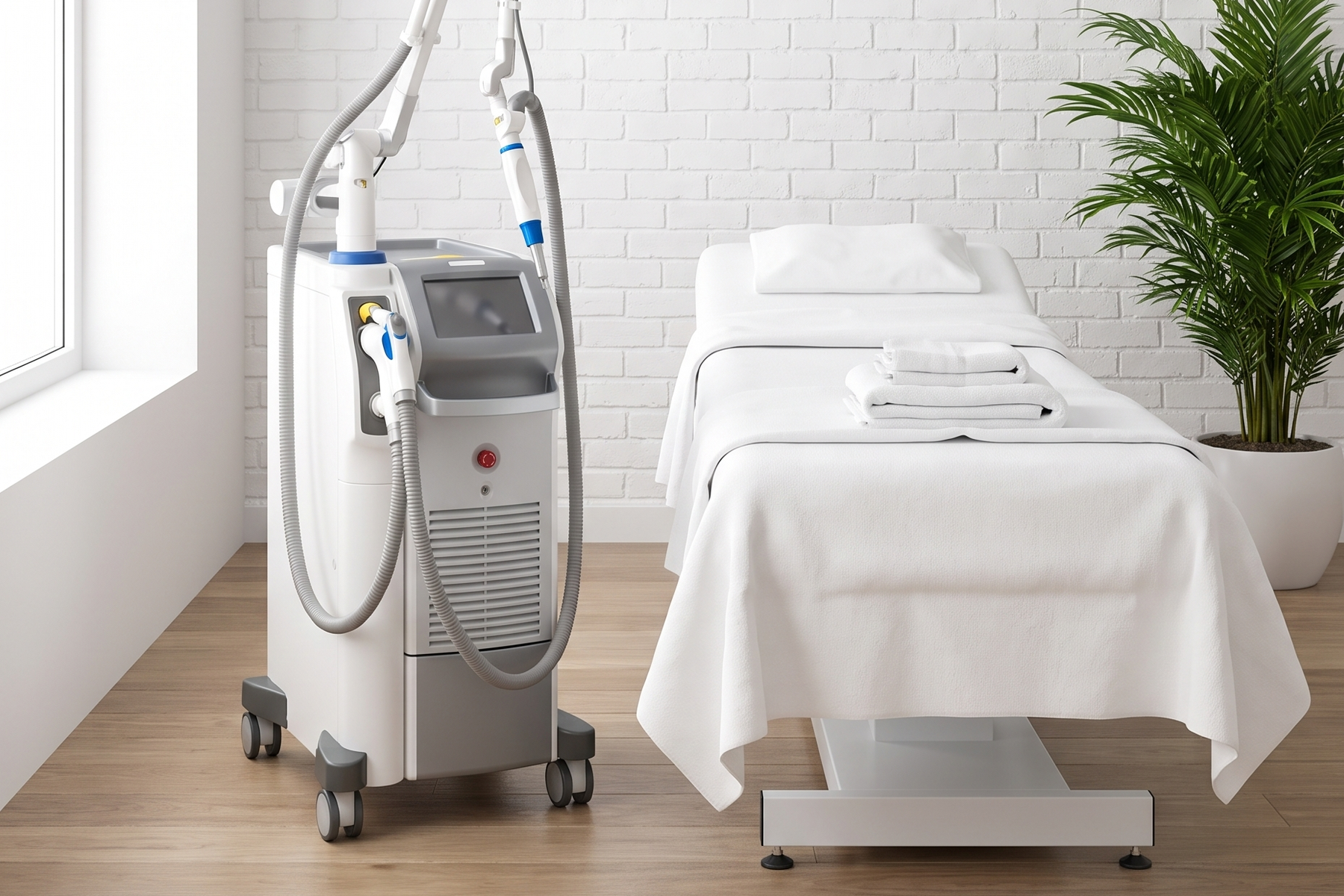
People search for "Fotona laser" as if it were one procedure, then find the same name attached to facial tightening, snoring treatment, hair removal and nail fungus. The reason is that Fotona is a laser platform, not a treatment. The device carries two wavelengths, and each mode is a particular way of using one or both on a particular tissue.
This guide explains what the platform is, what each mode is for, who suits which mode, what a session involves, how downtime and session counts differ, what the risks are and how to start. It draws on our own Fotona laser treatments in Montreal page and on published evidence.
What is the Fotona laser platform?
Fotona is a Slovenian laser manufacturer whose systems combine two lasers in one unit. The first is an erbium:YAG (Er:YAG) laser at 2940 nanometres. Water in the outer layers of the skin absorbs this wavelength almost entirely, so its energy stays near the surface. Depending on the settings it can remove a controlled layer of skin, which is called ablation, or heat the surface without removing it.
The second is a neodymium:YAG (Nd:YAG) laser at 1064 nanometres. Water absorbs it weakly, so it passes through the surface and deposits heat in the deeper dermis and in structures that contain pigment or blood, such as hair follicles and small vessels.
Lasers of this class are licensed as medical devices in Canada and appear in Health Canada's Medical Devices Active Licence Listing.
Which Fotona modes do our clinics use, and what is each one for?
Our treatment page lists the modes used across our clinics.
Ablative resurfacing and micro laser peel use Er:YAG to remove a very thin layer of skin for texture, fine lines, sun damage, uneven tone and acne scarring. This mode has the most visible recovery.
Skin tightening uses Nd:YAG heat in the dermis, sometimes with a non-ablative Er:YAG pass, to prompt collagen remodelling on the lower face, jawline, neck, eyelids and body. Fotona 2D, 3D and 4D are staged combinations of these modes on the face, described in the next section.
SmoothEye, listed on our page as smooth eye contouring, is a non-ablative Er:YAG mode that tightens the thin skin of the lids without removing tissue. Intraoral lifting applies the same mode from inside the mouth.
Anti-snoring treatment, known by the manufacturer's name NightLase, applies non-ablative Er:YAG to the soft palate to tighten it and reduce vibration during sleep.
Permanent hair reduction uses long-pulsed Nd:YAG, absorbed by pigment in the follicle, and can be used across the range of skin tones. Vascular lesion treatment uses the same wavelength to close small visible vessels such as spider veins and to reduce the redness of rosacea.
Wart, skin tag and tattoo removal use focused energy to remove the lesion or break up pigment. Acne and acne scar treatment combines Nd:YAG heating with Er:YAG resurfacing. Nail fungus treatment heats the nail plate and bed with Nd:YAG.
What is Fotona 4D?
Fotona 4D is the platform's best-known facial protocol. It is not a separate machine but four steps in one session, each using a different mode at a different depth: an intraoral pass that heats the cheeks and lips from inside, a fractional non-ablative Er:YAG pass over the surface for texture, a Nd:YAG pass that heats the deeper dermis for tightening, and a light Er:YAG peel to refine tone. Fotona 2D and 3D are the same idea with fewer steps.
A prospective study in Lasers in Surgery and Medicine in 2026 used three-dimensional imaging to measure four full-face Fotona 4D sessions, one month apart, in thirteen women. It found measurable tightening at the outer eye and midface at one week and at three months, with partial rebound but persistent mild improvement at six months, and only temporary redness and swelling.
Who suits which Fotona mode?
Candidacy is decided mode by mode. Resurfacing suits skin with texture, sun damage, fine lines or scarring. Tightening modes and Fotona 4D suit mild to moderate laxity of the face, neck or body; they produce a measurable but modest change, and with heavy skin excess the consultation will discuss other options.
Hair reduction and vascular treatment suit most skin tones, although very light or grey hair responds poorly because the laser targets pigment. Anti-snoring treatment suits adults whose snoring comes from a lax soft palate rather than from sleep apnea, which needs a medical assessment first.
As our page states, people who use tanning salons or have a history of skin cancer need to consult their doctor first.
What does a Fotona session involve?
Once the consultation has set the mode and settings, the area is cleaned, photographed and fitted with protective eyewear.
Topical anaesthetic is not needed. The platform is used with a cooling system that keeps the surface comfortable, and most people describe the sensation as warmth or pressure while the handpiece moves steadily over the area delivering pulses of energy.
Sessions run from fifteen to ninety minutes depending on the mode and the area. A small area such as the upper lip is at the short end; a full-face Fotona 4D session is at the long end, and very large areas may be split over several visits.
What is the downtime for each mode?
Non-ablative modes, which include tightening, SmoothEye, intraoral lifting, anti-snoring, hair reduction and vascular treatment, leave warmth and mild redness for a few hours to a day, and normal activities resume the same day.
Ablative resurfacing and micro laser peel remove a layer of skin, so redness and peeling last two to three days and the skin looks and feels sunburned. Fotona 4D sits between the two, since only its final light peel is ablative.
For any mode, our aftercare asks you to keep the area out of the sun, avoid heat such as saunas, avoid exercise that makes you sweat or flush, and avoid scrubbing, shaving or peeling the treated skin for the first five days.
How many Fotona sessions are needed, and when do results appear?
Plans run from one to six sessions depending on the mode. Resurfacing is often one or two sessions; tightening and Fotona 4D are usually three or four about a month apart; hair reduction needs a series because only follicles in their growth phase respond to each pass.
Early improvement usually appears within days to weeks, and the full result develops over two to six months as new collagen forms.
Published trials give a sense of scale. A randomised controlled trial in the European Archives of Oto-Rhino-Laryngology in 2023 compared three NightLase sessions with sham treatment in forty adults with primary snoring: snoring scores rated by patients and bed partners improved in the laser group and did not change in the sham group, with no anaesthesia needed and no complications. A study in Dermatologic Surgery in 2004 measured roughly forty to fifty percent mean hair reduction six months after three long-pulsed Nd:YAG sessions in thirty-six patients of all skin types.
Nail fungus is less settled. A randomised trial in the Journal of the European Academy of Dermatology and Venereology in 2017 gave twenty patients four short-pulsed Nd:YAG treatments alongside a topical antifungal and found no complete mycological cure at twelve months, so the authors proposed the laser as an add-on rather than a stand-alone therapy. Laser is therefore one part of a fungal nail plan, not a replacement for medical treatment.
What are the risks and side effects of Fotona treatment?
Our page lists the expected temporary effects: sensitivity, irritation, redness, swelling and itchiness, and less often a hive-like reaction or a temporary change in pigmentation. These generally settle within days.
Pigment change is more likely on tanned skin or skin exposed to the sun soon after treatment, which is why sun avoidance is asked for before and after each session. Blistering, infection and scarring are rare with correct settings and aftercare, and any effect that lasts longer than expected should be reported to the clinic.
Is Fotona laser treatment worth it?
It depends on matching the mode to the concern. Fotona is worth considering for surface texture and sun damage, mild to moderate laxity, unwanted hair, small vessels, warts or a lax soft palate. It is a less useful choice for large volume loss, deep folds or heavy skin excess, which point toward filler, threads or surgery.
How much does Fotona laser treatment cost in Montreal?
Pricing depends on the mode, the size of the area and whether a single session or a package is planned. Our Fotona treatment page lists the current price range, and the exact quote for your plan is confirmed at the consultation once the mode and number of sessions are set.
What is the first step?
Book a consultation at one of our three clinics in the Montreal area, with your skin untanned if possible. The consultation identifies which mode fits your goal and sets out the sessions, downtime and cost before anything is booked.
You can browse all of our aesthetic treatments to see how Fotona fits alongside the other options for the face and body.
Results vary from person to person and are not guaranteed. Nothing here is medical advice — book a consultation and we will look at your case.
Sources
Keep reading

Laser Skin Rejuvenation After 40: Which Treatment Is Best?
After 40, the best laser depends on whether you want to treat wrinkles, pigmentation, texture or skin firmness. Compare Fotona 4D, Pico Laser, Laser Genesis and CO2 resurfacing.
Read
Can Fotona 4D Rejuvenate Your Face Without Surgery?
Fotona 4D combines four laser steps to improve facial firmness, fine lines and skin texture without surgery. Discover how it works, expected results, recovery and treatment costs.
Read
Preventative Botox: When Should You Start?
There is no perfect age to start preventative Botox. Discover when early expression lines may justify treatment, how it works, and what to consider in your 20s and 30s.
Read