Blog
2026 · 7 min read
Radiesse or Hyaluronic Acid Filler: Which Do You Need?
Radiesse lasts 12 to 18 months and cannot be dissolved. Hyaluronic acid is reversible in minutes. Here is how the two materials differ and which areas each one suits.

Key facts
- Radiesse is 30 percent calcium hydroxylapatite microspheres, 25 to 45 microns, suspended in a 70 percent carboxymethylcellulose gel.
- Hyaluronic acid filler can be dissolved with hyaluronidase; calcium hydroxylapatite has no enzymatic reversal agent.
- The gel carrier in Radiesse is cleared by the body within 6 to 8 weeks, leaving the microspheres to stimulate collagen.
- Published data put the average duration of calcium hydroxylapatite at 12 to 18 months, with some results noted at 24 months.
- Radiesse is not used in the lips or the glabella, and lip augmentation studies reported nodules in 12.4 percent of subjects.
- Health Canada approved a décolleté indication for Radiesse in June 2025 using a 1 to 2 dilution with sterile saline.
Radiesse and hyaluronic acid filler both smooth folds, but they are different materials doing different jobs. Radiesse is 30 percent calcium hydroxylapatite microspheres suspended in a gel, it lasts about 12 to 18 months, and it cannot be dissolved. Hyaluronic acid can be dissolved in minutes.
That last difference is the one most people do not hear about until afterwards, and it should be part of the decision rather than a footnote to it.
What is Radiesse made of?
Radiesse is 30 percent calcium hydroxylapatite microspheres, 25 to 45 microns across, suspended in a 70 percent water-based carboxymethylcellulose gel. Calcium hydroxylapatite is a mineral compound closely related to what bone and teeth are made of, which is why it is described as a bioceramic rather than a gel.
It is licensed by Health Canada as a Class 3 medical device under two active licences held by Merz North America. The Canadian product information covers correction of moderate to severe facial wrinkles and folds such as nasolabial folds, correction of facial fat loss in people with HIV, and rejuvenation of the hands. Health Canada added a décolleté indication in June 2025, using a 1 to 2 dilution with sterile saline.
One thing to be careful about if you have been reading American sources: jawline contouring is an approved indication in the United States, not in Canada. If a Montreal clinic is offering Radiesse for the jawline, that is an off-label use here, which is legal and common in medicine but worth knowing you are consenting to.
How does it work differently from filler?
Radiesse does two things on two different clocks.
On the day, the gel carrier provides volume. It is injected at a one-to-one correction ratio, meaning what you see at the end of the appointment is roughly what was placed.
Then the gel goes. It is cleared by the body within six to eight weeks, and what stays behind is the calcium hydroxylapatite microspheres, which act as a scaffold that fibroblasts respond to by producing collagen. Studies have measured increases in type I and type III collagen, and animal work found new collagen growth continuing for at least twelve months.
A hyaluronic acid filler has no second phase. The gel is the result for its whole lifespan, and it holds water, which is part of why it looks the way it does. When the gel goes, the correction goes.
So the honest framing is that Radiesse is partly a filler and partly a collagen stimulator, and hyaluronic acid is a filler. Whether that is an advantage depends entirely on what you are treating.
Which one is right for what?
Hyaluronic acid tends to be the better answer when you need precision, softness, or the ability to change your mind. Lips are the clearest case, and Radiesse is not used in lips at all. Fine work near the eye, anywhere the skin is thin, and any first-time treatment where you are not sure you will like the outcome all point toward hyaluronic acid.
Calcium hydroxylapatite tends to suit deeper structural work where the tissue is thicker and the goal is support rather than detail. Nasolabial folds are its named Canadian indication. Hands are a licensed use and a genuinely good one, because the problem there is volume loss over tendons rather than a line to fill.
In a split-face comparison, evaluators rated calcium hydroxylapatite superior to a hyaluronic acid filler in the nasolabial folds in 47 percent of patients and inferior in 5 percent. That is a real difference, but it is one comparison in one anatomical area, and it does not transfer to the rest of the face.
If the underlying issue is skin laxity rather than lost volume, neither product is the answer, and something like thread lifting or an energy-based tightening treatment is a different conversation worth having first.
Can Radiesse be reversed?
No, and this is the part to sit with.
Hyaluronic acid filler can be dissolved with hyaluronidase, an enzyme that breaks it down within hours. That is why it is the default for anyone new to injectables, and it is also the emergency tool if filler compromises a blood vessel.
There is no equivalent for calcium hydroxylapatite. A published review found no evidence that hyaluronidase breaks down calcium hydroxylapatite, and it has no enzymatic reversal agent of its own. Merz's Canadian product information puts it plainly: the implant can be added to in a later session, but cannot be easily removed.
Sodium thiosulfate comes up in discussions as a possible dissolving agent. The evidence is contradictory. Some studies found partial reduction, others found none, and reviewers have advised against relying on it in an emergency. Treat calcium hydroxylapatite as permanent until it resorbs on its own.
This is not an argument against the product. It is an argument for choosing your injector on anatomy rather than price, and for starting with something reversible if you are unsure.
How long do the results last?
The most cited figure is an average of 12 to 18 months, from a decade-long clinical review, with some results noted at 24 months. A follow-up study found 40 percent of treated folds were still graded as improved or better at least 30 months after the last treatment.
Results vary from person to person. Faster metabolism, more mobile areas and smaller volumes all shorten it.
What are the risks?
Expected effects are redness, swelling, lumpiness, pain, itching, discoloration and tenderness at the site. Swelling usually settles in seven to ten days but can persist longer, and numbness should resolve within four to six weeks.
Nodules are the specific risk. In a review of just over 5,000 patients, early adverse events occurred in 21.8 percent, delayed reactions in 0.85 percent, and severe complications in 0.27 percent. Nodule rates are strongly site-dependent: 12.4 percent in lip augmentation, which is one of the reasons lips are contraindicated, 3.7 percent in radial lip lines, and 6.2 percent in hands, all mild in that series.
The serious risk, as with any facial injectable, is vascular occlusion. A review of 43 published calcium hydroxylapatite cases found the nose, nasolabial folds and glabella were the most common sites. In the cases involving vision, only 40 percent reported complete or near-complete recovery. Radiesse is not used in the glabella for this reason.
Radiesse is not used where there is active infection or inflammation, in patients prone to hypertrophic scarring, in the presence of previous permanent fillers, in the breasts, or in the lips.
What should I ask before booking?
Ask which product the injector is proposing and why that one for your specific area. Ask what happens if you get a nodule. And ask what their plan is if a vessel is compromised, because with calcium hydroxylapatite the answer cannot be "we dissolve it."
In Quebec, an in-person medical assessment is required before injectable aesthetic treatment, and a physician must remain accessible to manage a reaction. If you are weighing several options, it helps to look at what else is available before settling on a single product, since the right answer is often a combination rather than a choice.
Results vary from person to person and are not guaranteed. Nothing here is medical advice — book a consultation and we will look at your case.
Sources
- https://www.merzcanada.com/files/radiesse-volumizing-filler-ifu.pdf
- https://health-products.canada.ca/mdall-limh/information?licenceId=95140&type=active&lang=eng
- https://health-products.canada.ca/mdall-limh/information?licenceId=78893&type=active&lang=eng
- https://www.merzaesthetics.ca/fr/radiesse/
- https://jcadonline.com/calcium-hydroxylapatite-over-a-decade-of-clinical-experience/
- https://www.oaepublish.com/articles/2347-9264.2022.09
- https://academic.oup.com/asj/article/43/10/1063/7249933
- https://academic.oup.com/asj/article-abstract/30/2/235/345209
- https://www.mdpi.com/2079-9284/11/5/165
- https://www.mdpi.com/2077-0383/13/6/1686
Keep reading
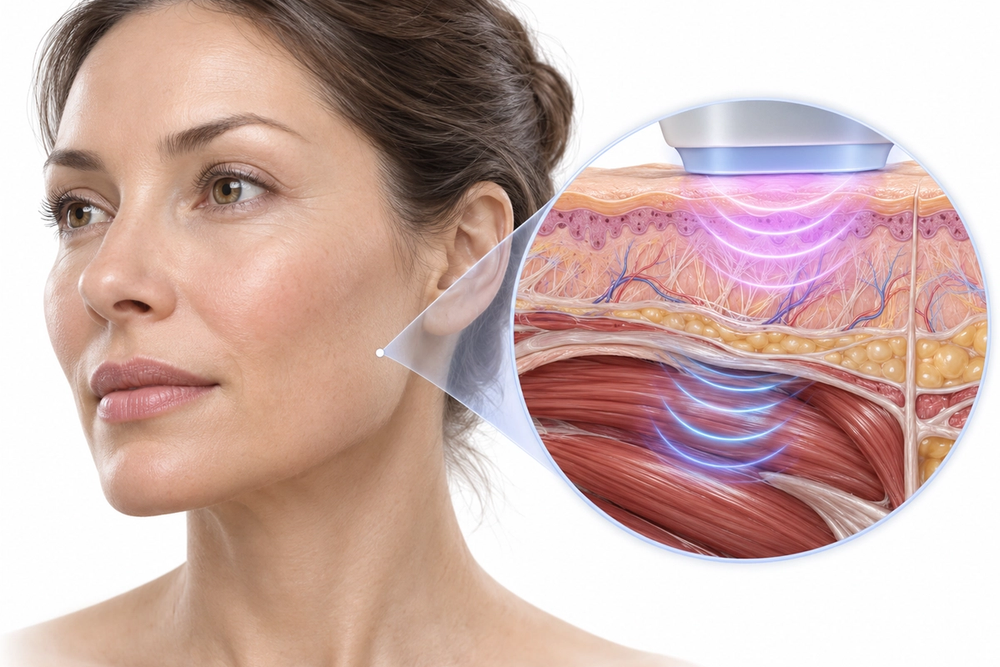
Can TriLift Tighten Your Face Without Surgery in Montreal?
TriLift combines facial muscle stimulation and radiofrequency to improve the appearance of facial tone and firmness. See how sessions, pricing, results and recovery work.
Read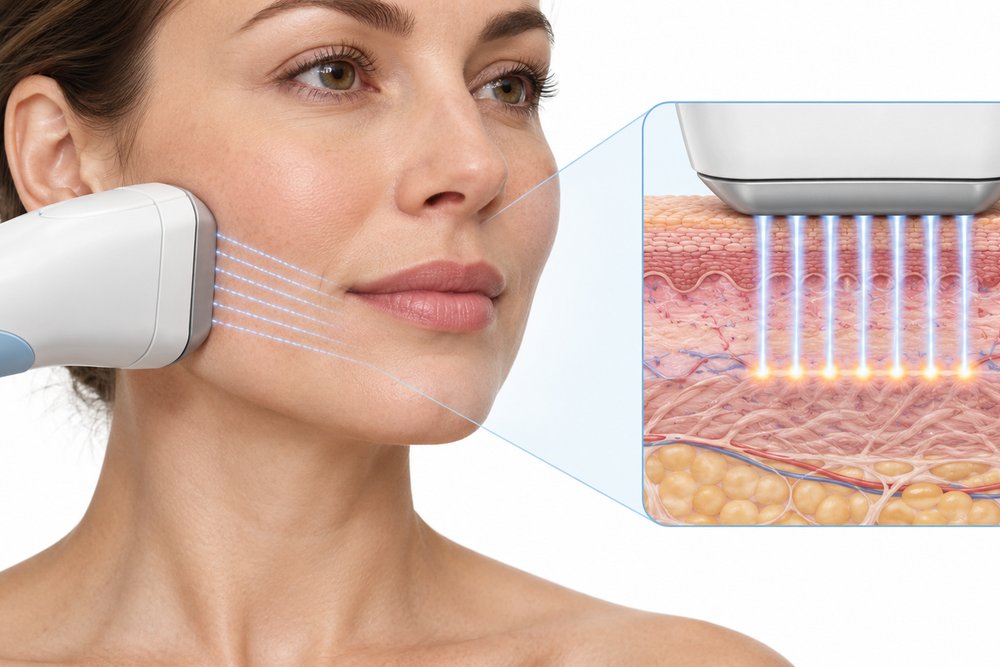
Does Sofwave tighten the face and neck without surgery?
Sofwave can improve mild facial and neck skin laxity without surgery. See how ultrasound treatment works, when results appear, what recovery involves, and Montreal prices.
Read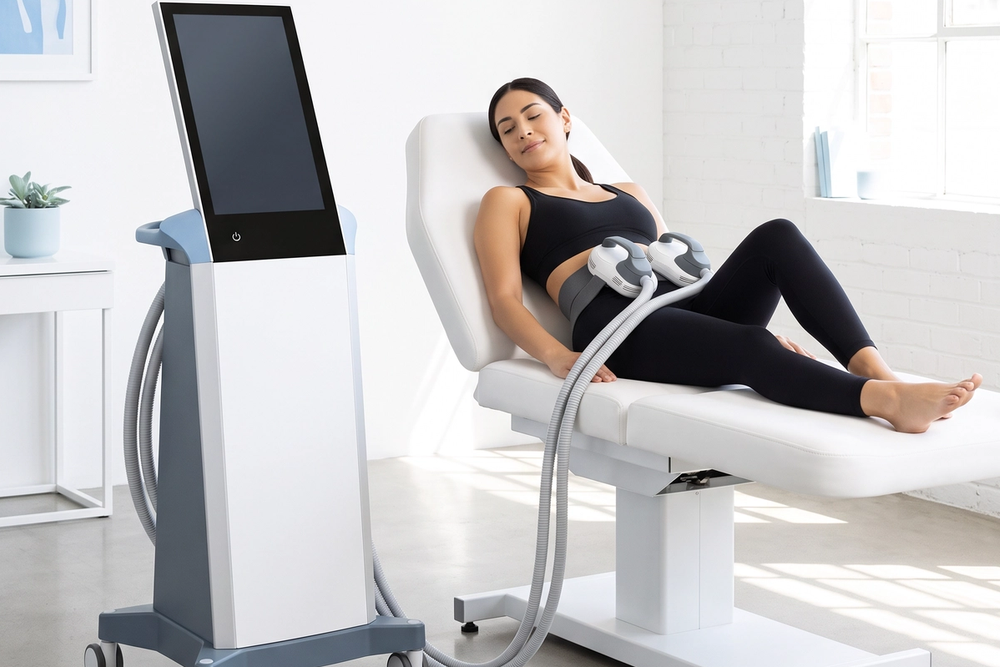
Body Contouring Compared: EMSCULPT NEO, CoolSculpting and Venus Bliss MAX
EMSCULPT NEO, CoolSculpting and Venus Bliss MAX reduce fat by three different mechanisms, and only two of them build muscle. Here is what each one does, which areas it treats, how many sessions to expect and how they combine.
Read