Blog
2026 · 6 min read
What Does Sculptra Do, and How Long Does It Take?
Sculptra stimulates your own collagen over 3 to 6 months rather than filling a line on the day. Here is the session count, the results timeline, and the nodule risk worth knowing first.
Key facts
- Sculptra is licensed in Canada as a Class III medical device under Health Canada licence number 71658.
- Most Sculptra plans use about 3 sessions, and the manufacturer asks for reassessment no sooner than 4 weeks after each one.
- Collagen type I increases after poly-L-lactic acid injection were statistically significant at 3 and 6 months in a published biopsy study.
- Sculptra results have been reported lasting up to 25 months, and safety beyond 2 years has not been studied in controlled trials.
- Papules and nodules are the most frequently reported post-marketing event for Sculptra, appearing at 3 to 6 weeks or from 1 to 14 months.
- Galderma's Canadian guidance asks patients to massage treated areas for 5 minutes, 5 times a day, for 5 days after injection.
Sculptra is a collagen stimulator, and most patients need about 3 sessions spaced 4 to 6 weeks apart. It does not fill a line on the day you have it. It prompts your own skin to build collagen over the following 3 to 6 months.
That gradual timeline is the single most important thing to understand before booking, because it changes what a good result looks like and when you should judge it. If you want a visible change this weekend, this is the wrong treatment. If you want facial volume to come back slowly enough that nobody can name what you had done, it is the right one.
What is Sculptra made of?
Sculptra contains microparticles of poly-L-lactic acid, a synthetic polymer that the body breaks down and absorbs over time. It is licensed in Canada as a Class III medical device (Health Canada licence number 71658, held by Q-Med AB, part of Galderma) and has been licensed here since 2006.
The Canadian product information describes it as suitable for increasing the volume of depressed areas, including skin creases, wrinkles, folds and scars, and for signs of facial fat loss, in patients over the age of 21.
Worth knowing: the poly-L-lactic acid is not the volume. It is the signal. The liquid it is mixed with disperses within days, and what remains is a stimulus that your fibroblasts respond to by laying down new collagen. A biopsy study published in Dermatologic Surgery found a statistically significant increase in type I collagen at three and six months after injection.
How is it different from a filler?
A hyaluronic acid filler in Montreal is the volume. Inject two millilitres, and two millilitres of gel is sitting there holding up the tissue when you walk out. It is immediate, it is measurable, and it can be dissolved with an enzyme if you dislike it.
Sculptra is the opposite on every one of those points. Nothing is holding anything up on day one. The change arrives over months, it is not reversible with an enzyme, and it fades slowly rather than stopping.
Neither approach is better. They answer different questions. A defined lip border or a specific hollow under the cheekbone is a filler problem. Diffuse volume loss across the temples and midface, the kind where you cannot point at one spot, is closer to what a collagen stimulator is designed for. Plenty of treatment plans use both, and some pair it with wrinkle relaxing injections for the upper face, where the issue is muscle movement rather than volume.
What happens on the day, and afterwards?
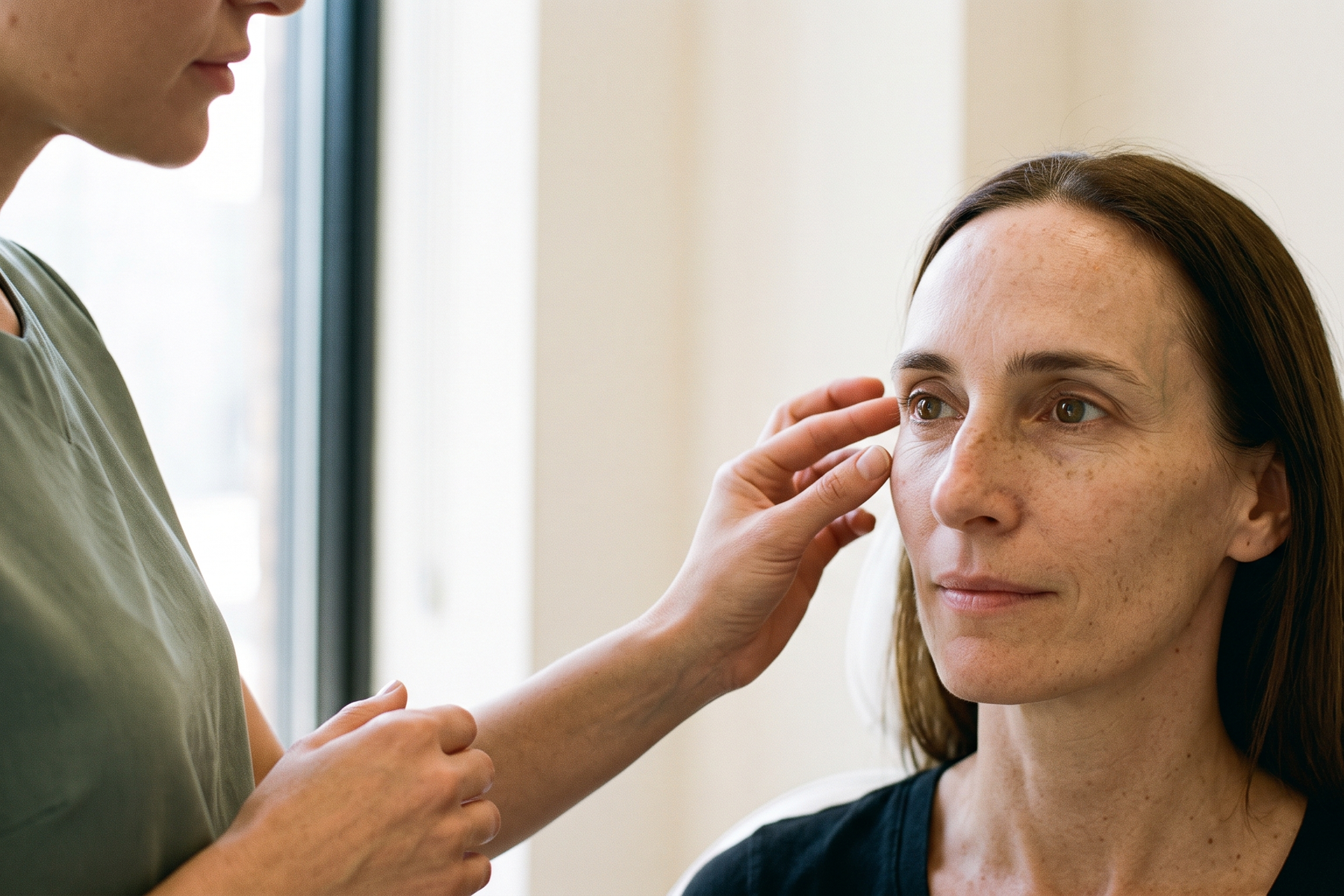
The appointment runs about 30 to 60 minutes. The product is injected into the deep dermis, and the area is massaged so it distributes evenly.
You will probably leave looking fuller than you did when you arrived. That is swelling from the injection fluid, not the result, and it settles within hours to a few days. The Canadian product information is direct about this: patients see the original contour deficiency reappear as the swelling goes, which is expected and not a sign the treatment failed.
The aftercare instruction that matters most is the massage. The manufacturer's Canadian guidance asks patients to massage the treated areas for five minutes, five times a day, for five days. Ice helps with swelling and bruising. Avoid strong sun, UV lamps and extreme temperatures until any redness has settled.
How many sessions will I need?
Galderma's Canadian guidance puts the average at three sessions over a few months. The product information asks that a limited correction be done first, then the patient reassessed no sooner than four weeks later to decide whether more is needed.
That four-week floor exists because the result is still developing. Judging it early and asking for more is how people end up overcorrected, and overcorrection is one of the recognised causes of nodules.
When will I see results, and how long do they last?
Initial change shows over several weeks. The measurable collagen response in the biopsy data appeared at three and six months, so the honest answer is that the treatment is finished long before the result is.
For duration, a controlled trial of nasolabial fold correction reported improvement lasting up to 25 months, and Galderma's Canadian materials cite results lasting up to two years. Results vary from person to person, and the product information notes that safety and effectiveness beyond two years have not been studied in controlled trials.
What are the risks?
Injection-site bleeding, pain, redness, bruising and swelling are common and generally resolve within two to six days.
The specific risk worth understanding is nodules. In Health Canada-registered post-marketing reporting, papules and nodules are the most frequently reported event for this product. They come in two patterns: early ones at three to six weeks, often linked to dilution and injection technique, and delayed ones anywhere from one to fourteen months later. Published aesthetic-patient series have reported rates around 8.5 percent, and one study using a higher dilution protocol reported 1.3 percent compared with 8 percent on a standard protocol. Most resolve, some need treatment, and a small number have required surgical removal.
Rarely, any facial injectable can enter a blood vessel, which can cause vision loss, stroke or skin necrosis. This is the reason the injector's anatomical knowledge matters more than anything else in the room.
Sculptra is not used in patients with a history of anaphylaxis or multiple severe allergies, in anyone allergic to its components, or where there is active infection or inflammation at the site. It is not injected into the red part of the lip. Safety in pregnancy, breastfeeding and under-18s has not been established.
Who is a poor candidate?
Anyone who needs to look different by a fixed date. Anyone with a history of keloid scarring or an autoimmune condition, which should be raised at consultation. Anyone on immunosuppressive therapy, where caution applies. And anyone whose expectations cannot be met by what the treatment does, which the product information names directly as an unsuitable candidate.
In Quebec, injectable aesthetic treatment requires an in-person medical assessment before any product is given, and the Collège des médecins du Québec requires that a physician remain accessible to manage a reaction. If you are comparing clinics, that is a reasonable thing to ask about.
What should I ask at my consultation?
Bring three questions: how many sessions do you think I need and why, what dilution do you use, and what happens if I get a nodule. An injector who answers all three plainly is telling you a lot about how they work.
If you are still deciding between approaches, it is worth seeing the full range of treatments before committing to one, since volume loss, skin laxity and muscle movement are three different problems that often show up together.
Results vary from person to person and are not guaranteed. Nothing here is medical advice — book a consultation and we will look at your case.
Sources
- https://www.galdermaaesthetics.com/ca/sites/default/files/2025-03/IFU%20Sculptra%20-Jul%202022%20copy.pdf
- https://health-products.canada.ca/mdall-limh/information?licenceId=71658&type=active&lang=eng
- https://www.galdermaaesthetics.com/ca/sculptra-how-it-works
- https://www.galdermaaesthetics.com/ca/sculptra-reduce-wrinkles-saggy-skin-revitalize-with-collagen-activation
- https://pubmed.ncbi.nlm.nih.gov/20159311/
- https://pubmed.ncbi.nlm.nih.gov/23464798/
- https://www.mdpi.com/2073-4360/16/18/2564
- https://cms.cmq.org/files/documents/Guides/p-1-2020-08-24-fr-guide-medecine-esthetique.pdf
Keep reading
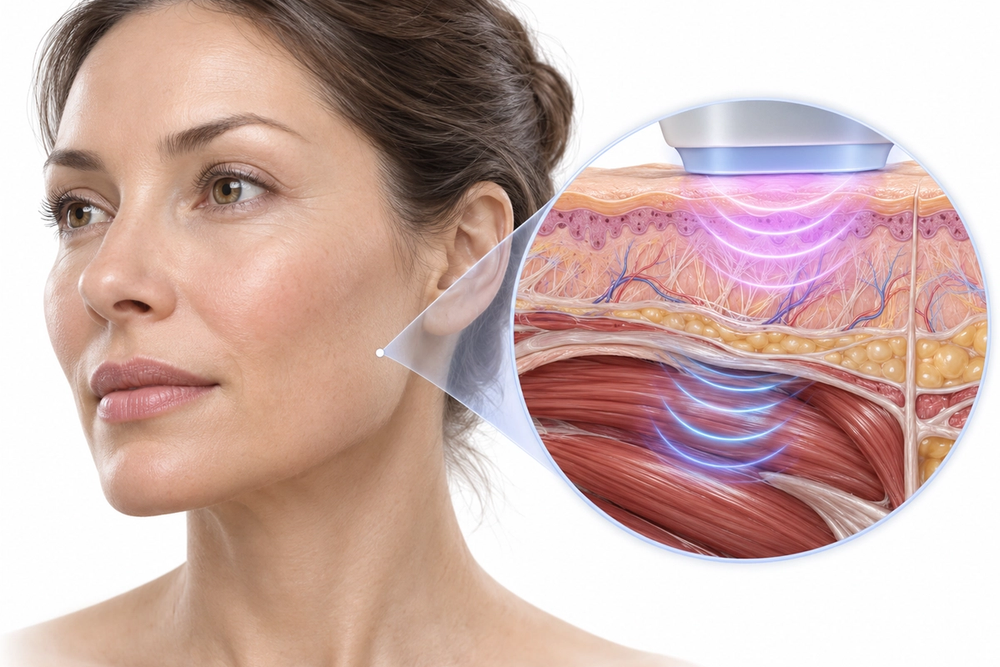
Can TriLift Tighten Your Face Without Surgery in Montreal?
TriLift combines facial muscle stimulation and radiofrequency to improve the appearance of facial tone and firmness. See how sessions, pricing, results and recovery work.
Read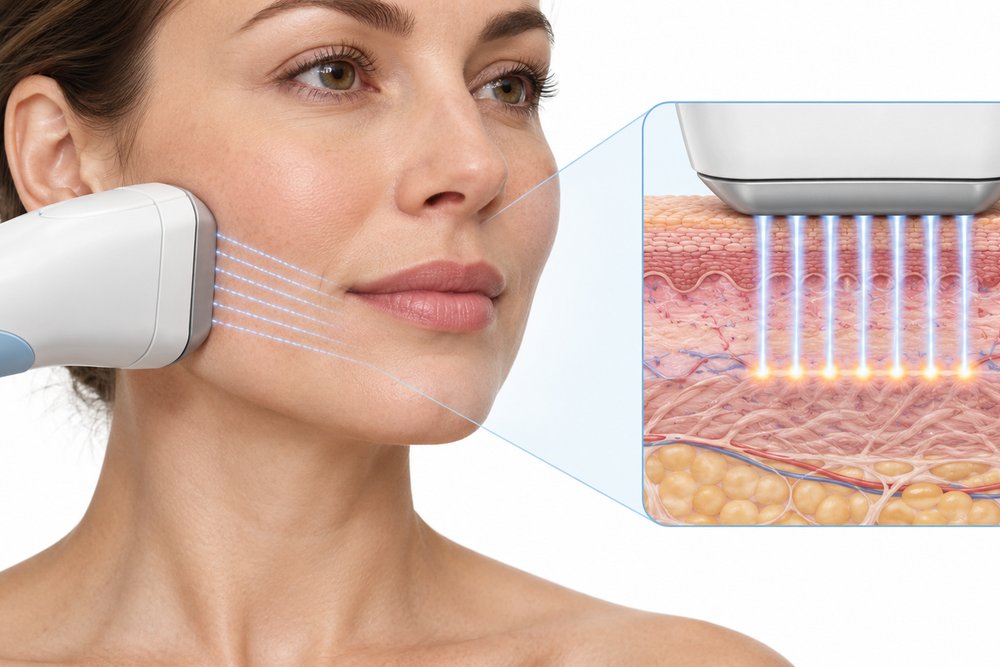
Does Sofwave tighten the face and neck without surgery?
Sofwave can improve mild facial and neck skin laxity without surgery. See how ultrasound treatment works, when results appear, what recovery involves, and Montreal prices.
Read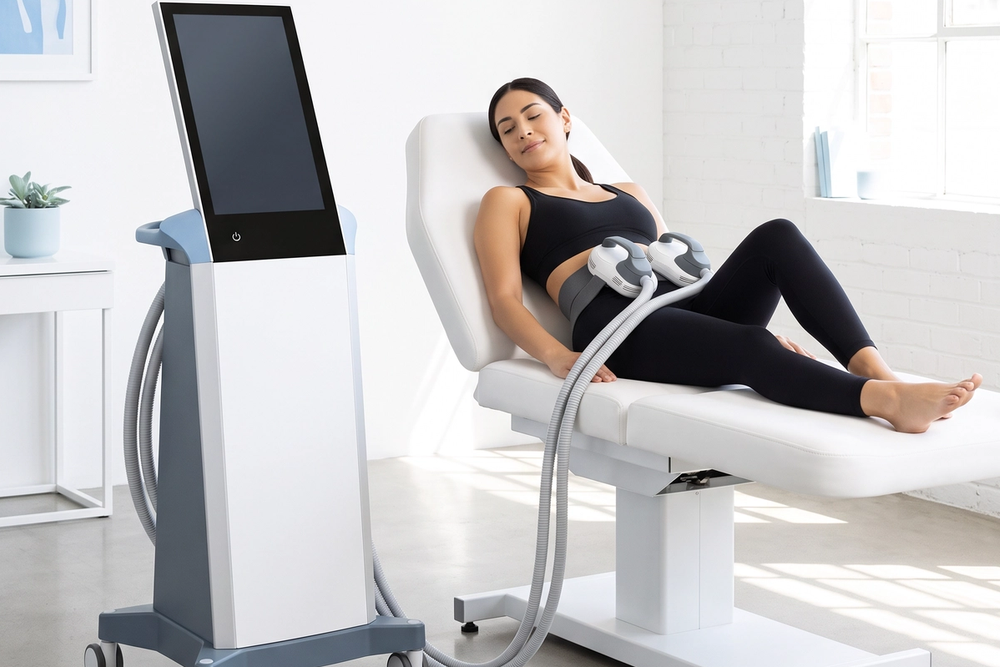
Body Contouring Compared: EMSCULPT NEO, CoolSculpting and Venus Bliss MAX
EMSCULPT NEO, CoolSculpting and Venus Bliss MAX reduce fat by three different mechanisms, and only two of them build muscle. Here is what each one does, which areas it treats, how many sessions to expect and how they combine.
Read